

Hello there,
Happy Man City beat Liverpool at Anfield Sunday, to all who celebrate.
What a great week it has been for African fintech. If you missed Friday’s newsletter, catch up on the Danfo Run and Lagos Life games, as well as Nigerian Stablecoin activity, catch up here.
🇪🇬 Egyptian fintech unicorn MNT-Halan listed 20% of its shares in its $149 million IPO on the Cairo Stock Exchange. A transaction that represents the largest IPO on the Egyptian exchange since 2021.
🇬🇧 Airtel Money Africa started trading on the London Stock Exchange after an IPO in which existing investors sold $703 million of shares. The deal values the company at $7 billion and has been billed as London’s biggest IPO since Wise in 2021.
🇳🇬 Nigeria’s leading consumer payments platform OPay has filed its IPO prospectus, an F-1, with the SEC to list on the NYSE under the ticker $OPAY. Initial estimates suggest the company intends to raise over $500 million in the transaction, which would see the company valued at over $4 billion.
Our Read: OPay’s IPO intent is a positive development for an ecosystem that has been starved of exit activity. In a world where companies are staying private for longer to avoid public market scrutiny and reporting oversight, Africa gets two fintech IPOs and a prospectus in a week.
As is custom with every IPO, analysis and narratives will be created around the company, the industry it plays in, competition and risk factors. The revelations by OPay in this document have provided much-needed narrative violation for a few strongly held beliefs about Nigeria and the industry they operate in.
Similar to Interswitch (more on that below), 89% of their revenue comes from the Nigerian market, and they claim to be the 3rd and 4th highest-ranked app overall in Nigeria by Daily Active Users and Weekly Active Users. They’re also the only financial application to break into the Top 5 overall ranking.
OPay looks like a payments app, but most of its money comes from lending and float.
Loan interest, loan facilitation fees and interest on invested customer savings were 70% of H1 2026 revenue. After credit losses, lending still delivers about half of the contribution.
In typical fashion, the Nigerian internet loves to compare fintechs with more established traditional banks. Unfortunately, this document and performance are an indictment of Interswitch. Them not going hard on credit, cross-border payments and agency banking is a miss.
Winners:
The OPay team for creating such a juggernaut
Telnet, which sold a controlling stake in Paycom to Opera in 2018
Early employees who we hope held equity or at least have bragging rights
The Standard Bank team, which has agreed to buy up to $200 million of new OPay shares at the IPO price
African markets and the ecosystem: 3 IPOs in one year, and OPay plans a secondary listing on the Nigerian Exchange after it lists in New York
Missing:
The absence of Nigerian investment banks and advisors on this deal.
What Next:
The CBN needs to ask them to become a fully fledged commercial bank at this rate. It’s a lending platform masquerading as a payments engine.
With 50 million monthly users, $979 million in deposits, $536 million in revenue, and a $1.56 billion loan portfolio, adding a $400 million war chest to this combination that does not get charged a CRR debit is an unfair market advantage.
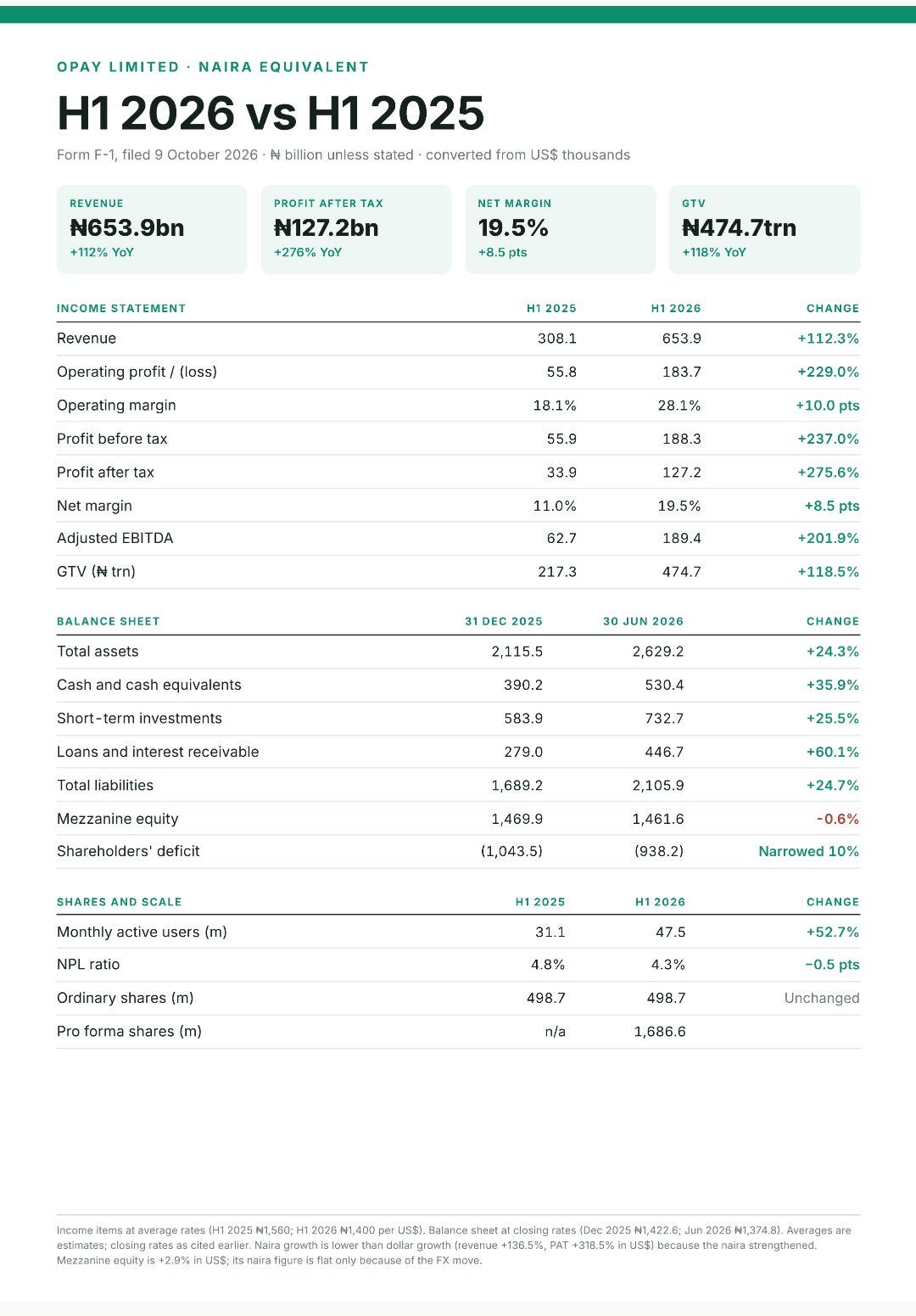
*While microfinance banks like OPay hold 20% of their deposits in Treasury bills, commercial banks, by comparison, leave 45% of their deposits with the CBN as sterilised deposits.
This also means no one has an excuse next year. Interswitch, Paga, Flutterwave, Moniepoint, Kuda, PalmPay.
It’s your time to grow up, folks.
Good luck 😁
And now, on to the newsletter.
Last month, for Africa Built, the podcast I run with Olumuyiwa of Not a Deep Dive, we spent over 12 hours researching Interswitch, Nigeria’s first fintech unicorn. That research led to over 5 hours of audio, which we edited into a two-part series.
The podcast is live on all podcast players as “Africa Built” or via the website at africabuilt.xyz, where we share more trivia and analysis that we cut from the recordings.
Four episodes in, I have learnt that the research process and the recordings are the easy parts. Once the podcast is live, we still have to promote it and get people to listen to it.
Today’s newsletter is one of those promotional attempts: a summary of our analysis and the series on Interswitch. It was written entirely by my personal AI agent, based on the podcast transcripts and our research notes.
Let us know your thoughts on this format in the comments. All feedback would be appreciated.
The Interswitch Story - Africa Built Version.
Interswitch has an unusual problem. It can lose a customer to a competitor and still help process that competitor’s payments.
That is a useful place to start with a company that is often described as Nigeria’s first fintech unicorn. How did a business backed by seven banks become critical infrastructure for an industry that now competes with it?
For our two-part Interswitch series, we went back to the engineers who connected Nigerian bank branches in the 1980s, followed the money into the founding consortium and Helios, and then looked at what happened when the company had to compete with a new generation of fintechs.
There are wins, missed opportunities and a recurring question: what do you build after you become part of the plumbing?
Listen to Part I: The Interswitch Story: From Telnet to Helios and Part II: The Interswitch Story: Visa, Verve, and IPO?.
Before the ATM in Scotland
The familiar founding story starts with Mitchell Elegbe using an ATM in Scotland. The machine swallowed his card, inspiration struck, and Interswitch followed.
It is a good story. It is also doing too much work.
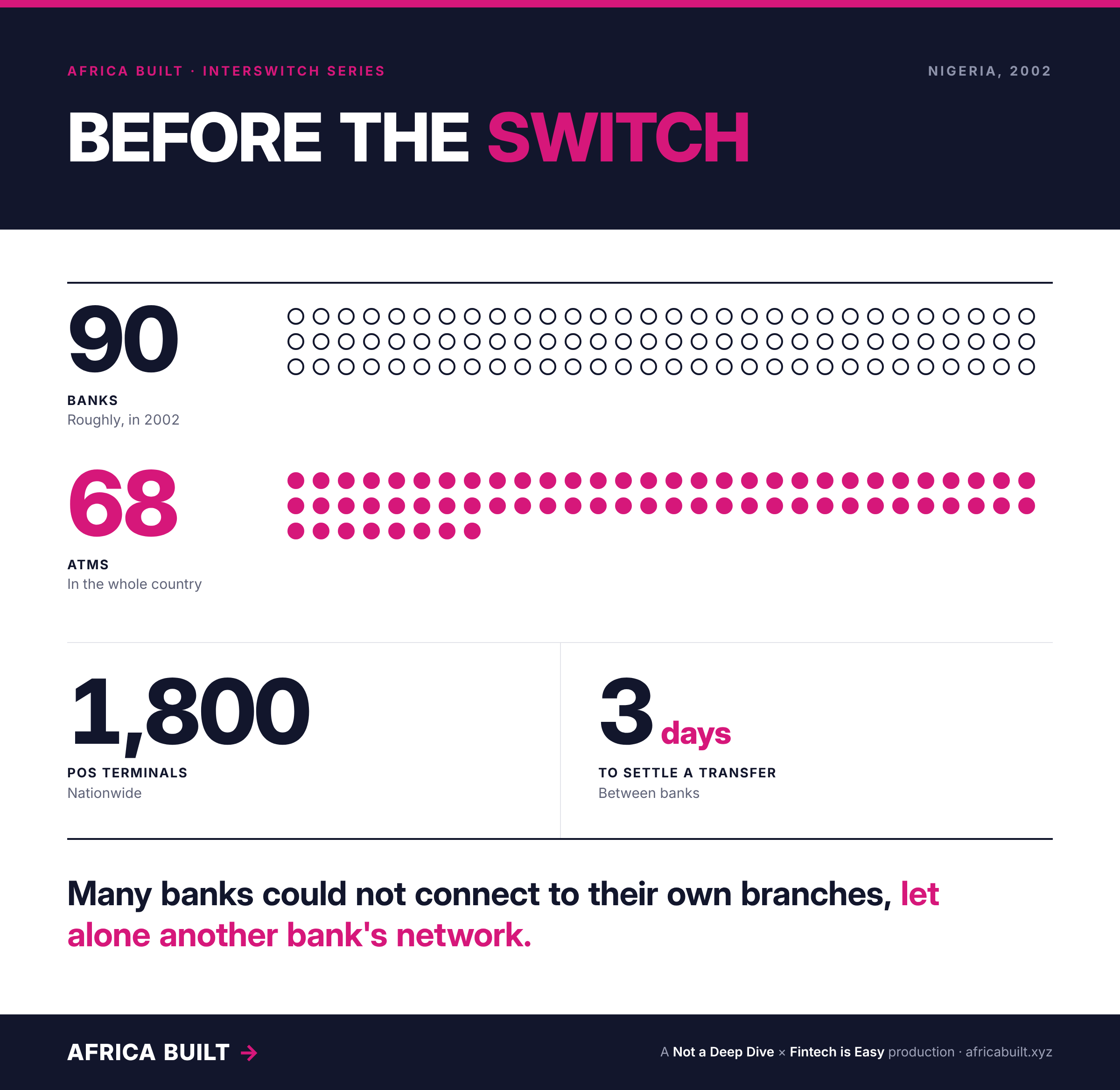
Nigeria already had ATMs. What it lacked was a banking system where your card worked wherever you needed it. A customer could have money in one bank and find another bank’s ATM useless. Even branches of the same bank struggled to communicate. Your account was tied to the branch where you opened it.
To understand how that changed, we start with TCASS, and with engineers Dr Burian Carew and Dr Nadu Denloye, who went on to build Telnet. Their work included connecting branches for Société Générale and Citibank’s Nigerian business. That meant dealing with the physical limits of Nigerian telecommunications, unreliable links and the practical business of keeping a network running.
Elegbe’s own career fits into that history. He worked at Computer Systems Associates, where the work included connecting banks to SWIFT, and had two spells at Telnet, with Schlumberger in between. The Scotland incident may have been a catalyst. It was not the beginning of his exposure to the problem.
The longer story matters because Interswitch did not arrive in an empty market. It came out of years of engineering, relationships with banks and knowledge of what did not work.
Seven banks, one trust problem
Getting the technology to work was only part of the job. Why would one bank agree to depend on another bank’s network? And why would anybody go first if the value depended on everybody else joining?
The answer was an unusual ownership structure.
With Accenture helping shape the business plan, and Adedotun “Dotun” Sulaiman as chairman, seven banks committed ₦200 million in 2002. Techinvest, from the Telnet group, and Accenture were also among the founding shareholders. The banks invested through the Small and Medium Industries Equity Investment Scheme, or SMEEIS.
The cap table was part of the product. Rival banks could own the shared network while a separate company operated it. They were investors, customers and distribution partners at once.
Elegbe became CEO, but he was initially an employee without equity, rather than the venture-backed founder we would recognise today. The operating team, including Charles Ifedi and Akeem Lawal, would earn ownership as the business grew.
Interswitch used Postilion switching software to help connect the banks. The basic achievement sounds almost boring now: a UBA card could work in a First Bank ATM. At the time, that was the point. Money in your account became useful beyond your own bank’s machines.
The products were answers to ordinary problems
The next stage was about what people could do with those connections.
PayDirect made collections easier. A DStv customer no longer needed to withdraw cash and take it to a MultiChoice office to renew a subscription. An Oando dealer could make a payment, get confirmation and collect goods without waiting for an accountant to reconcile the transfer manually.
Those examples are less glamorous than a unicorn announcement. They explain the business better. Interswitch grew by solving problems for companies whose own growth depended on collecting money reliably.
WebPay took that work onto the internet. Airlines, online retailers and other merchants could accept card payments on their websites. Quickteller brought bills, airtime, transfers and other payments into a common interface, first on the web and then through an app. Its reach also extended through APIs that other businesses could use.
There were other answers to the same market. ValuCard’s ePurse let customers load money onto a card, working around the limits of connectivity. Interswitch bet on connecting the accounts and institutions themselves. Better connectivity made that bet more useful over time.
By December 2010, a Helios-led investor group had agreed to acquire a majority interest in Interswitch. The company had moved from a bank-backed network to a private-equity-backed business. The banks that helped build it could realise value, and the operators had built something much larger than the original assignment.
WebPay lost ground. Verve did not.
One of the tensions in the series is that a product can be important and still be unpleasant to use.
WebPay helped make Nigerian online commerce possible. It also came with bank-led onboarding, an upfront integration charge discussed in the episode as ₦150,000, and developer support that left smaller businesses frustrated. Large companies could absorb the cost and hire somebody to get it working. For a small merchant, that could be the difference between selling online and not selling online at all.
Paystack and Flutterwave made that gap their opportunity. Easier integration and a different pricing model gave merchants another way in.
Could Interswitch have cut its price before those challengers arrived? Probably. Would that have been an easy argument inside a business making money from the existing model? Much less clear. Hindsight makes every missed opportunity look obvious.
Verve tells the other side of the story.
Launched in 2009, the domestic card scheme became more attractive as foreign-exchange shortages and naira depreciation made international card relationships more expensive for Nigerian institutions. Banks and fintechs needed a card suited to local customers and local payments. Verve was already there.
In Part II, we discussed its rise to roughly 60% of Nigeria’s card market. The same currency conditions that made Interswitch’s dollar valuation harder to defend helped strengthen one of its most important products.
Success brings its own arguments. We also discuss complaints about Verve’s pricing and the arrival of AfriGO as a domestic challenger. Being essential does not mean your customers stop caring about what you charge them.
A unicorn in dollars, a business in naira
Visa’s 2019 investment gave Interswitch a $1 billion valuation. Contemporary Reuters reporting put the deal at $200 million for a 20% stake. For Visa, it meant a seat at the table of a major African payments business, including the company behind a competing domestic card scheme.
Then comes the less tidy part.
The figures we discussed in Part II put annual revenue at about ₦39 billion in 2021 and ₦137 billion in 2025. That is a mature business growing quickly. But most of its revenue still comes from Nigeria. Strong naira growth does not automatically become strong dollar growth when the currency is losing value.
The episode examines a reported $750 million valuation for the 2022 LeapFrog and Tana investment round. That is the basis for the “no longer a unicorn?” question, rather than a fresh price for the company today.
Our discussion is less interested in policing the label than in what sits underneath it. Nigeria gave Interswitch the market, relationships and distribution that made the business possible. Nigeria also exposes it to currency risk, inflation and a revenue base concentrated in one country. Both things can be true.
The IPO that keeps waiting
Interswitch explored a listing in the 2015-16 period and returned to the idea in 2019. The earlier window ran into Nigeria’s recession and currency problems. The later push went further, alongside public financial disclosures, a bond programme and Visa’s investment, before the pandemic changed the environment again.
This was not simply a company saying “IPO soon” while keeping its books out of sight. The disclosures gave outsiders material to work with. They are part of why we could do this series.
But being ready to list and finding the right moment to list are different problems. A possible sale was also discussed during the earlier exit planning. Helios and the other shareholders still face the question of how to turn ownership into liquidity.
Expansion has not removed that question. Interswitch pursued businesses in other African markets, including Gambia and Kenya, but the Nigerian revenue base remained dominant. We discuss retreats and reduced stakes, as well as diversification into healthcare through eClat, telecoms through VANSO and investments in businesses such as ACE Logistics, OkHi and Shuttlers.
More businesses and more countries do not necessarily mean a less concentrated business. The numbers have to follow the ambition.
The company, and the industry it helped create
There is another way to measure Interswitch’s reach: look at who left.
Tosin Eniolorunda went on to build TeamApt, now Moniepoint. Ope Adeoye built OnePipe. Former Verve CEO Mike Ogbalu III now leads PAPSS, the Pan-African Payment and Settlement System. The people who learned payments inside Interswitch have taken that knowledge into new companies and new infrastructure.
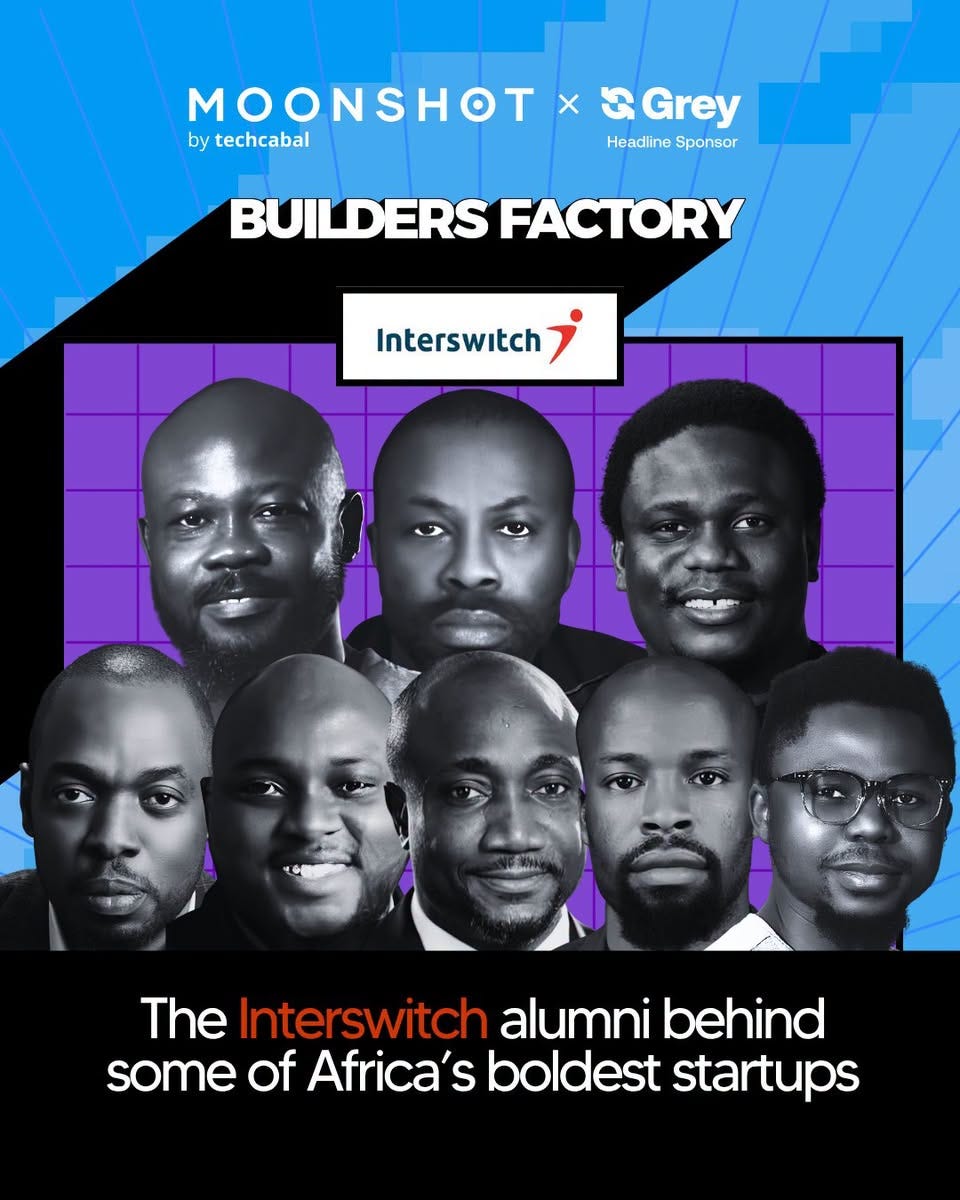
Some became competitors. That is part of the achievement.
Our final argument is that Interswitch has reached something like public-utility status. We mean its place in the industry, not government ownership: other businesses can build on it, compete with it and still depend on parts of what it provides.
That does not excuse every missed opportunity. Paystack and Flutterwave in web payments, and OPay and Moniepoint in everyday payments and agency banking, show that incumbency is no guarantee. Verve and collections show that losing one market does not mean losing the company.
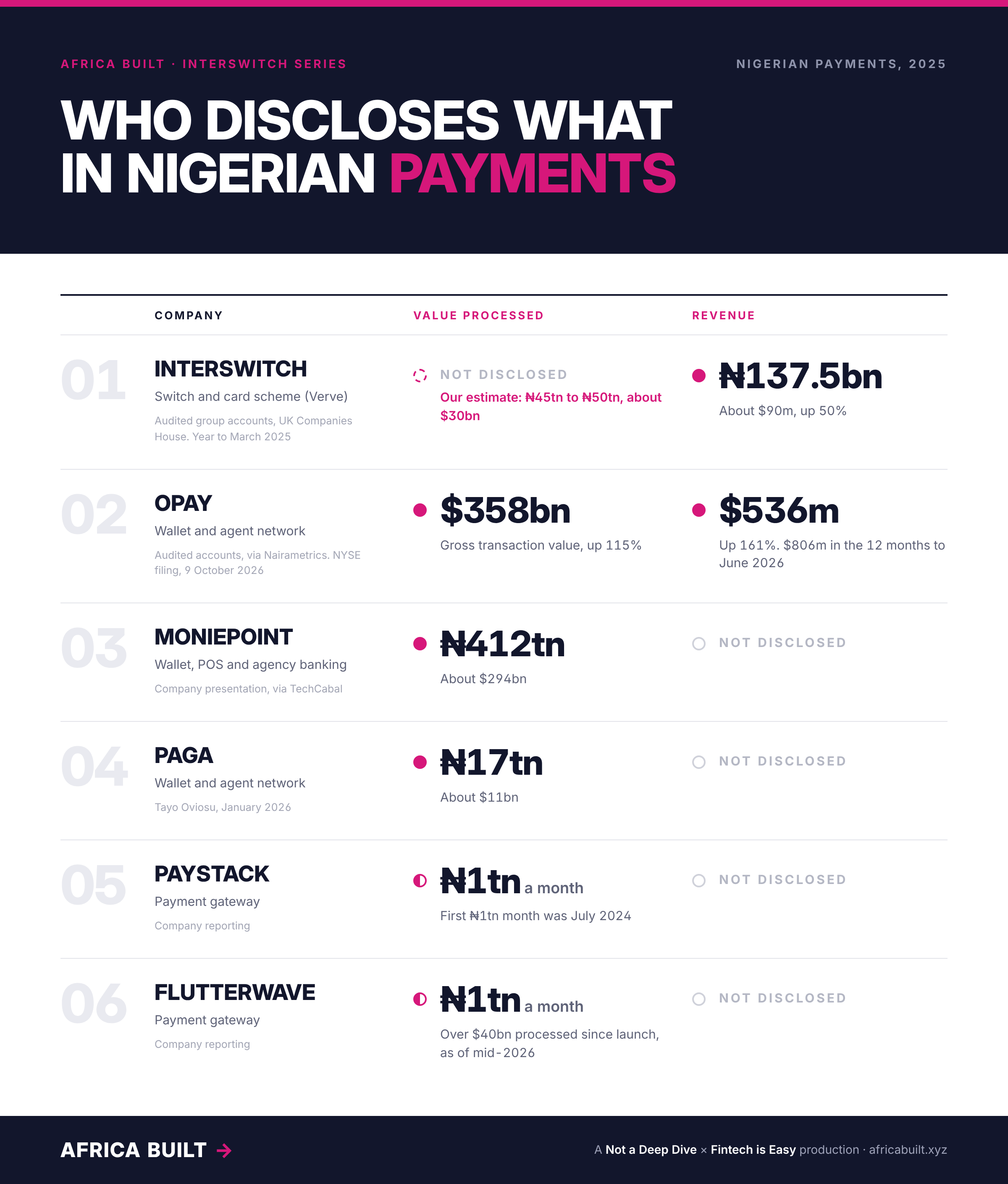
The next decade should ask more of it. We talk about contactless and QR payments that reduce the work of paying, cross-border opportunities, and my recurring suggestion that Interswitch (and all fintechs) should grow up and become proper banks. These are arguments about what it could build, not announcements of what it has committed to do.
The original problem was getting banks to talk to each other. The next one is finding what an already connected industry still needs.
Listen to Part I · Listen to Part II
Next Time on AfricaBuilt: The Godfather of the Internet
Africa Built is a Not a Deep Dive x Fintech is Easy production.
Have a correction, a missing piece of the history or a story from inside the industry? Write to africabuiltpod@gmail.com or message us on every social media platform @africabuiltpod or africabuilt.xyz
This series is for education and entertainment, not investment, tax or legal advice.
A Few Nice Links
Decoding Bharat - The Indian pivot
Is OPay Really Okay? - Uncle Tunde’s Insights
OPay’s cheap deposits - Not a Deep Dive
Mitchell Elegbe: Dream Big, Execute with Knowledge - The Platform Nigeria
This letter by U.S. Treasury Secretary Scott Bessent to Sen. Elizabeth Warren