


Hello there,
How are your New Year’s resolutions going? Apparently, Something Big is happening, and we are speedrunning towards the 2028 global intelligence crisis.
We wrote an article reflecting on Nigerian VCs over at NotaDeepDive - please read here.
Headlines
🦞OpenAI acqui-hired Peter Steinberger, the creator of OpenClaw, for an undisclosed sum.
🛒Amazon officially dethrones Walmart as the world’s largest company by annual revenue, crossing $717 Billion in sales.
🏹Robinhood launches a private markets fund offering clients exposure into companies like Databricks, Revolut, Ramp, Airwallex, Boom Supersonic, and Stripe.
🇬🇧The UK’s FCA selects Monee, ReStabilise, Revolut and VVTX to test stablecoin innovation in its Regulatory Sandbox.
💳Stripe released its 2025 letter reporting 2025 processing volumes of $1.9 trillion.
💲Paypal ousted its CEO and is currently attracting acquisition interest from Stripe, Elon Musk, and other competitors.
🇫🇷A data breach at the French National Bank account registry (FICOBA) affected 1.2 million customers.
📉Jane Street has been accused by Crypto insiders of market manipulation in a new lawsuit.
₿ Crypto exchange Bithumb erroneously sent 1.5BTC to thousands of users. Total loss was 2,000 BTC.
🚨🙋🏽♀️🙋🏽♂️Applications are now open for the Money 20/20 Europe RiseUp and Amplify programmes - Deadline for submissions is March 2.⚠️

Last year, we wrote about the real cost of building a truly global digital bank, using Revolut and Zap by Paystack as references. A lot has changed in the last year, and that deserves a sequel.
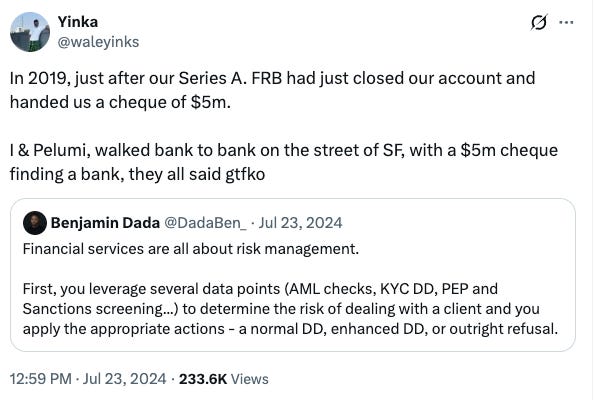
In 2019, Adeyinka Adewale, the founder of Nomba, had just closed his Series A. First Republic Bank had shut down the company’s account and handed them a cheque for $5 million.
He and his co-founder then did something that sounds like fiction: they walked from bank to bank on the streets of San Francisco, cheque in hand, trying to find a bank willing to take their money. Every bank said no.
A Nigerian startup, backed by real institutional capital, physically holding a $5 million cheque in the startup capital of the world, and not a single bank would let them open an account.
This is not a story about one unlucky founder. This is the story of how the global financial system treats roughly 70 countries and the businesses that operate within them. And it is not, despite what the discourse might suggest, a uniquely Nigerian problem.
The World That Made This Necessary
I have argued on numerous occasions that local banking/money transfer is a solved problem in many parts of the world. But since the WTO, Globalisation, and the internet heralded a new era of human connectivity and trade, we all needed sustainable ways of transacting around the world that the legacy banking system, powered by SWIFT, could not cater to and adjust for - (also written here).
With the USD being the de facto currency of the world, and what most central banks hold reserves in, by default, accessing basic global banking products means either having a USD account or the ability to send and receive USD with local currency or via local rails seamlessly.
That is the way of the world we live in today.
If you are a founder, freelancer, or small business operating out of most of Sub-Saharan Africa, large parts of Southeast Asia, Latin America, or the Middle East, accessing basic global banking products such as a USD account, a functioning international wire, a business account that your investors, customers, clients, can actually send money to ranges from difficult to genuinely impossible.
Reputational risks for most countries also mean that senders are hesitant to send money to banks in these countries, even when the receiver account is a USD-denominated account.
Many bank tellers and correspondent banks have reversed legitimate transfers to certain jurisdictions due to various legitimate and spurious reasons, causing more headaches and inconvenience for senders and receivers.
This is not a newsletter of geopolitics, but as the Payments Culture newsletter shared this month, money and geopolitics structurally go hand in hand despite our best intentions to be neutral.
Y Combinator, the tech accelerator programme, used to require every participant to incorporate in Delaware and open a US bank account. Simple enough if you are from San Francisco. Not so simple if you are from Lagos, Nairobi, Jakarta, or São Paulo.
Founders accepted into a programme that has produced companies worth hundreds of billions of dollars collectively still arrive in the United States, unable to open a basic bank account. Some have had to fly to entirely different cities just to find a branch willing to take them on.
So here you are, deemed worthy of investment by the sharpest early-stage investors in the world. You have a Delaware C-Corp. You have capital commitments. And you cannot open a bank account.
For a while, Mercury was the answer.
The San Francisco-based financial provider became the lifeline for a generation of internationally founded companies. It understood startups. It was fast. It was digital. It did not require you to show up physically at a branch in a city you had never visited.
For African founders especially, Mercury became the default: if you raised in dollars, you banked with Mercury.
Then, in March 2022, Mercury restricted the accounts of over a dozen tech startups — including companies backed by YC — without warning or clear explanation. Accounts were flagged and frozen. The reason given was “unusual activity.”
The actual reason, as many founders came to understand, was that their transaction patterns did not look like those of a typical Silicon Valley SaaS company. Because they were not typical Silicon Valley SaaS companies. They were African businesses operating across multiple currencies and jurisdictions, doing exactly what businesses in emerging markets do.
Then came July 2024, and the full ban. Mercury published a list of 37 prohibited countries. Nigeria was on it. So was Burundi, Cameroon, the Central African Republic, the Democratic Republic of Congo, Mali, Mozambique, Sudan, and Zimbabwe. The company cited “recent changes in how we determine account eligibility” — a phrase that explains nothing while saying everything.
Founders were given 30 days to move their money. No appeal process. No clear explanation of the policy change. Just carry your money and go.
Even the VCs sending the money faced problems on the other end. As Eghosa Omoigui of EchoVC Partners once put it, sending a wire from the US to a startup’s Nigerian domiciliary account was problematic. Correspondent banks held up wires and kept asking questions. The traditional banks were not built for this. And the global banks did not want the compliance risk.
The result was an entire ecosystem — not just in Nigeria, but across the Global South — forced into workarounds.
Founders asking friends in the US to open accounts on their behalf. Businesses losing 5-8% on every international payment through informal channels because the formal channels had failed them. Agencies invoicing in currencies they could not easily receive. Startups raising capital that they could not easily access.
Ask, and you shall find.
The market asked for local solutions with global access. And the market, as it tends to do, responded.
A wave of companies emerged over the past five years — Grey, Cleva, LemFi, Eversend, Chipper Cash, Nala, Raenest, and a host of others — all building some version of the same thesis: if the global financial system will not come to us, we will build the on-ramp ourselves.
Most of these started as consumer products. Multi-currency accounts for freelancers. Virtual cards for individuals to pay for USD-priced subscriptions, Remittance products for the diaspora, and currency exchange for the growing army of Africans, Latin Americans, and Southeast Asians earning in dollars and spending in local currencies.
To a reasonable degree, they have solved that problem. Getting paid as an individual for cross-border work is largely handled in 2026.
These companies have built worthy businesses to rival the darlings in this space: Wise, Revolut, N26, Monzo, Nubank - Not in volume, but in functionality, and solving the user needs of their chosen demographic.
But the real gap — business banking — remained wide open.
An African SME exporting design services to US clients cannot easily open a compliant USD business account. A Kenyan startup receiving payments from six different countries needs more than a personal multi-currency wallet. A Lagos-based founder who just raised a seed round needs to pay contractors in three currencies, manage supplier payouts, and send bulk payments. These things should not be done from a personal account.
Freelancers are also growing into becoming companies; the solo designer of today will be an agency tomorrow, a remote developer today can build a product being used and paid for by millions, and a content creator will become a media company with brand deals.
These people will require business banking solutions, and they do not want to switch platforms. They want the product they already trust to grow with them.
And that brings us to the sequel.
Enter Grey
Last year, I closed my piece on Revolut and the cost of building a global bank with a line that I thought was slightly tongue-in-cheek:
“At this point, let’s ask Revolut to purchase a Nigerian banking licence.”
It turns out the answer was not Revolut buying a Nigerian banking licence. It was a Nigerian-founded company building the global infrastructure and partnerships first and pointing it back at the markets that needed it most.
Grey was founded in 2020 as Aboki Africa by Idorenyin Obong and Femi Aghedo — two Nigerian software engineers who wanted to make it easier for people like them to receive payments for work without stress. That is the founding story they tell, and it is the founding story of half the companies in this space. What makes Grey different is what they did next.
They did not apply for a Nigerian banking licence. They did not try to build outward from Lagos. Instead, they incorporated in Delaware, got licensed through FinCEN in the US and FINTRAC in Canada, went through Y Combinator’s Winter 2022 batch, and built the global rails first(in partnership with Clear Junction). Then they pointed those rails at emerging markets — Nigeria, Kenya, Tanzania, Uganda, Brazil, Mexico, Indonesia, the Philippines, South Africa, Ghana, and over 60 other countries.
Today, Grey has nearly 3 million users, and according to them, the consumer product — multi-currency accounts, virtual cards, currency exchange — was always the foundation, not the destination.

I reached out to Grey after their business banking expansion announcement to understand what comes next, their competitive positioning, and their approach to multi-market compliance. Their answers showed their clarity of thought about the market they are serving.
On the timing of the business banking launch, Grey’s team was direct: the move was organic. They had been watching their personal account users behave like businesses for years. Freelancers who had become agencies. Solo founders who had become teams. Multiple payees. Higher volumes. A need for team access. A significant percentage of their user base was effectively running businesses through consumer accounts. Rather than fight that behaviour, they built for it.
“Over 1,000 businesses signed up during the public beta, and that told us the demand was not theoretical.” - a Grey Spokesperson
On the question of whether Grey is positioning itself as a safer home for African companies that have been debanked by Mercury and other American banks, the answer was more personal. They did not build Grey Business because they read about debanking in a news article. They built it because they have lived it, their friends have lived it, and their users have lived it.
The framing they used is worth paying attention to. Grey does not position itself as “anti” anyone. But they understand African and emerging market money flows in a way that Mercury’s compliance teams demonstrably do not. They understand why a Kenyan startup might receive payments from six different countries. That context means they serve these businesses properly rather than flag them as risky by default.
As they put it: “We’re a more informed home. Safety comes from understanding.”
That line is doing a lot of work. And it is aimed directly at the compliance-first-ask-questions-never approach that got Mercury(and PayPal) the reputations they have today on the continent.
What Grey Business offers now: USD corporate accounts, global send and receive across 170+ countries, real-time currency exchange, expense cards, and — critically — USDC stablecoin support.
That last piece is their deliberate bet that stablecoins represent an alternative rail that is faster and cheaper than traditional correspondent banking.
The same correspondent banking system that held up wires to Nigerian domiciliary accounts, the same system that made Mercury’s partner banks ban 37 countries, the same system where cross-border transfers cost businesses 6-7% on average, according to the World Bank.
The business product is live across all 70+ countries Grey currently serves, running on top of the infrastructure they have spent five years building for individual users.
Their MSB licences through FinCEN and FINTRAC cover the US and Canadian regulatory side, and they work with licensed banking partners in each market.
What Next?
When I asked about the product roadmap — lending, import finance(yes, I had to), business registration features in the mould of Stripe Atlas — Grey’s response was one of restraint.
In an ecosystem where every seed-stage company announces lending, insurance, and a super-app on their roadmap slide, Grey explicitly refused to announce features they have not built yet.
Their stated vision is to become the “complete financial operating system for businesses in emerging markets going global.” Payments is the foundation. They will build from there based on what users actually need.
Whether stablecoins become the default settlement layer for emerging market business payments or remain a niche option is one of the bigger open questions in fintech right now.
Grey is betting it is the former. Given what correspondent banking has done to their core market, you can see why.
On multi-market compliance, Grey was honest about the difficulty. Business compliance is harder than consumer compliance. They are being deliberate about building it right with their existing partners in these corridors. This matters as the quality of that compliance infrastructure will determine whether Grey can actually scale the business product without running into the same categories of risk that Mercury imposed on others.
The cite an advantage, though: five years of operating across these corridors for individual users gives them data, relationships, and pattern recognition, while business accounts carry higher stakes, they are deliberate about navigating this.
On competition, they do not think their biggest competition is another fintech – rather, it is the status quo. It is the founder still asking a friend in the US to open a bank account for their company. It is the business losing 5-8% on every international payment through informal channels because formal banking has failed them.
But competition is coming - from within and outside the continent, whether Grey frames it that way or not.
The five-year vision is ambitious: Grey wants to become the default financial platform for any business operating out of emerging markets.
Not just Africa, as they are already in Latin America and Southeast Asia. The business side, they believe, is where the real compounding happens. Business accounts are stickier, higher-volume, and higher-margin.
If even a fraction of their consumer base converts to Grey Business via the freelancer-becomes-founder pipeline they described, the unit economics shift dramatically.
Grey is a YC company. Could they possibly become the “default platform” for founders from the 70+ countries who have historically faced difficulties in opening global accounts?
The Closing Question
Wise received its first-ever African regulatory approval in December 2025 — conditional approval from the South African Reserve Bank. It processes over £185 billion in cross-border transactions annually and serves roughly 15.6 million customers. It is coming to the continent.
Revolut announced plans to apply for a full banking licence in South Africa in September 2025. It has over 65 million customers worldwide and is targeting 100 million by mid-2027. It has explicitly called South Africa a “key growth market.” It is also coming.
Mercury has now launched a consumer banking product.
The giants are building from the outside in. Grey built from the inside out.
The question is not whether there is a market. That was settled the day a founder walked the streets of San Francisco with a $5 million cheque and could not find a bank.
It was settled every time Mercury(and PayPal) froze an account.
Every time a correspondent bank held up a wire. Every time a compliance team looked at an African transaction pattern and decided to cancel the transaction and close the accounts, rather than get context over the phone.
Grey started global to serve local on the consumer side. Now they have to do it again on the business side.
A few Nice Links
Jevon’s Paradox is coming for Finance - Noah Levine
How Offline Payment Became the New Battleground for Nigerian Fintechs - NotaDeepDive
Payments no get enemy, until PayPal - Big Tech This Week
You’re not the best judge of yourself - A Couple of Things
What Doesn’t Change - Collaborative Fund
Why Strategic M&As Are Signs of a Healthy African Tech Ecosystem - Oui Capital
The Nigerian National Theatre’s second act - Communiqué