

In writing this newsletter, I try to balance the fact that I have two sets of audiences as readers and make each point land for both.
For this one, I have gotten help from Ngozi Chukwu, who used to run the logistics and mobility beat at TechCabal, to sharpen my read on Nigeria’s latest super app and the industry around it.
Happy reading.
Hello there,
In 2006, a hedge-fund manager caught between two blow-ups sat down to write his newborn son a letter about risk. The safe path was the wrong one, he wrote; disaster was a feature of any worthwhile attempt; the only failure that counted was failing to try.
The son was Aubrey Niederhoffer. Nineteen years later, he closed a $7.3 million seed round and launched a super-app in Lagos, a market that has previously killed five super-apps. They will be starting with food delivery, a business that has proven just as difficult and risky.
The obvious question is whether $7.3 million is enough to break a market this settled. The less obvious one, which I want to spend this piece on, is what kind of founder gets handed $7.3 million to try?
Chowdeck spent four years teaching Lagos that someone could make money delivering amala and jollof. Femi Aluko did it with bicycle routes threading the traffic and average cart sizes of less than five dollars(about ₦5,000), the kind of operational discipline that turns a category everyone had written off into a business that actually sustains itself.
That is what Swoop, an Eswatini startup that launched in May as a super-app— starting with the food delivery vertical—is up against: a profitable incumbent and a graveyard of better-funded corpses.
The sensible Lagos read is folly: after all, this category has refused to mint a super-app five times, and nothing about a teenager with a Silicon Valley cheque says the sixth time is the charm.
That read is correct. But Femi and Aubrey aren’t playing the same game. Femi has to build a business that generates real margins in this market because his next raise depends on it. Aubrey is being measured against Kaspi, WeChat, and against a last name that opens doors products can’t. Whether Swoop survives is beside the point. The $7.3 million pays out either way: riders, talent, restaurants, customers, validation. The only way to lose is to spend the moment arguing about whether it should have been funded at all.
The Niederhoffer game
To see why Aubrey gets that game, go back to the year he was born and the letter his father wrote him.
“Heroes must overcome risk, and they must have lofty goals. Anything good that you achieve in life is going to be fraught with risk and uncertainty.” Victor Niederhoffer, Letter to a Newborn Son, 2006. Written for Aubrey, age 0.
So what does the credential he was raised to chase actually do? Since 2011, Peter Thiel has paid roughly twenty people a year (now $250,000 each) to drop out of college and build something. Thiel bets that the conventional career track ruins people early, so he backs contrarians on conviction rather than traction: kids chasing ideas most people think are wrong.
The outcome is over 300 fellows in 14 years: 11 unicorns, over $100 billion in combined value. They’re also selected for pedigree, so the headline wins may reflect who they already were more than what the cheque did.
Look at how the winners win. Dylan Field got a Fellowship in 2012 and used it to build Figma, taking on design software, a category Adobe had owned for two decades. By 2022, Adobe was trying to buy Figma for $20 billion; regulators blocked the deal in 2023; Figma took the $1 billion break-up fee, kept building, and IPO’d in 2025 with a 250% first-day pop, the largest US venture-backed tech IPO in four years.
Laura Deming, one of the first 2011 fellows, proved that longevity could be a fundable category before #DontDie became a Silicon Valley obsession. Vitalik Buterin of the 2014 class built Ethereum, the rail underneath most of the decentralised money movement on the internet today, and a token worth over $190 billion.
That is the pattern to expect from Swoop: a Thiel Fellow enters a market everyone calls settled, takes losses longer than the incumbent expects, and survives to raise again, win, lose, or get acquired.
Aubrey is playing exactly that game. Chowdeck’s funding, KPIs and runway are all priced to win the market on the ground because they have to make the business work to raise again. Aubrey’s backers aren’t measuring him against Chowdeck; they’re measuring him against the size of his ambition and the rest of their portfolio.
He and the incumbents are not competing on the same axis.
What this category always leaves behind
The super-app era has already shown us that on every continent, the original thesis usually fails, and the infrastructure stays anyway.
WeChat and Alipay set the template: super-apps as de facto mobile operating systems, moving trillions. Everyone since has chased it the same way: raise an enormous sum, burn it for half a decade, transform the market, then list or die. Grab raised roughly $10.4 billion and lost $3.75 billion in 2019 alone before turning its first profitable quarter at the end of 2023; today it’s a roughly $15 billion Nasdaq company whose biggest business is the deliveries arm it scaled after absorbing Uber’s Southeast Asia operations in 2018. Rappi raised $2.3 billion, still isn’t profitable ten years in, and built most of Latin America’s urban delivery infrastructure on the way. Gozem raised a comparatively tiny $42 million and financed 7,000 vehicles across Francophone Africa that otherwise wouldn’t exist.
The numbers differ, but the trajectory doesn’t. The original thesis bends towards payments (Grab Financial, RappiPay, Gozem Money, OPay) because the food and the rides were only ever customer acquisition for the wallet. And the market transforms regardless of who wins: Indian hospitality professionalised on OYO’s back even as OYO lost three-quarters of its value. The company’s survival and the ecosystem’s gain are therefore decoupled here as the VC eats the loss and the city keeps the asset.
In Nigeria, we keep reading the results wrong
Nigeria has run this experiment five times and misread it every time. Habari, Jumia Group, Bolt Food, OPay’s super-app phase, Ayoba: every one a funded run at the same dream, every one a clean failure of the original thesis. We wrote the obituaries of those products and moved on.
But an obituary only scores the company. On a macro level, each of those bets paid salaries, pulled in foreign capital, shipped products nobody here had built before, and left a story the next group of founders could point to. The logistics layer, the payment rails, and the operator class they funded outlived the companies that paid for them. The Nigerian logistics market is now projected to hit $58.6 billion by 2029, assembled largely by players that won’t survive to enjoy it.
The talent outcomes also compound faster than the infrastructure. Jumia’s alumni became the “Jumia Mafia,” seeding a wave of African fintech and e-commerce startups, while the current Lagos and Nigerian diaspora operator pool grew out of failed and successful ventures alike. These are the people who staff whatever comes next, win or die; they know how to run operations at scale.
The graveyard tour is half the story. The infrastructure and talent are the other half we somehow never mention, and it’s that half that decides whether Swoop is worth anything, even if the super-app play fails and pivots like the others.
The market Swoop is swooping into
Nigerian food delivery was worth around $1.1 billion in 2025; Paystack reported a 187% increase in food delivery volumes on its rails between 2021 and 2024. Chowdeck (closely followed by Glovo) leads this sector with over 2 million customers, 20,000-plus riders, and a $9 million Series A. Beyond that, it has reported profitability, a feat no previous player managed.
Jumia Food never turned a profit from launch to its 2023 shutdown, and its CEO blamed deep-pocketed, aggressive rivals on the way out. Chowdeck has taught itself how to make money the hard way: managing an average basket size of $4.50, bicycles in the dense core of Lagos, and four years of operational learning a newcomer can’t put a price on.
Enter Swoop
Swoop launched in Eswatini in August 2025 as Thumo. In its first month, it acquired roughly 22,000 users, about 2% of the country’s adult population. It then rebranded, raised a seed round, and announced the Lagos expansion.
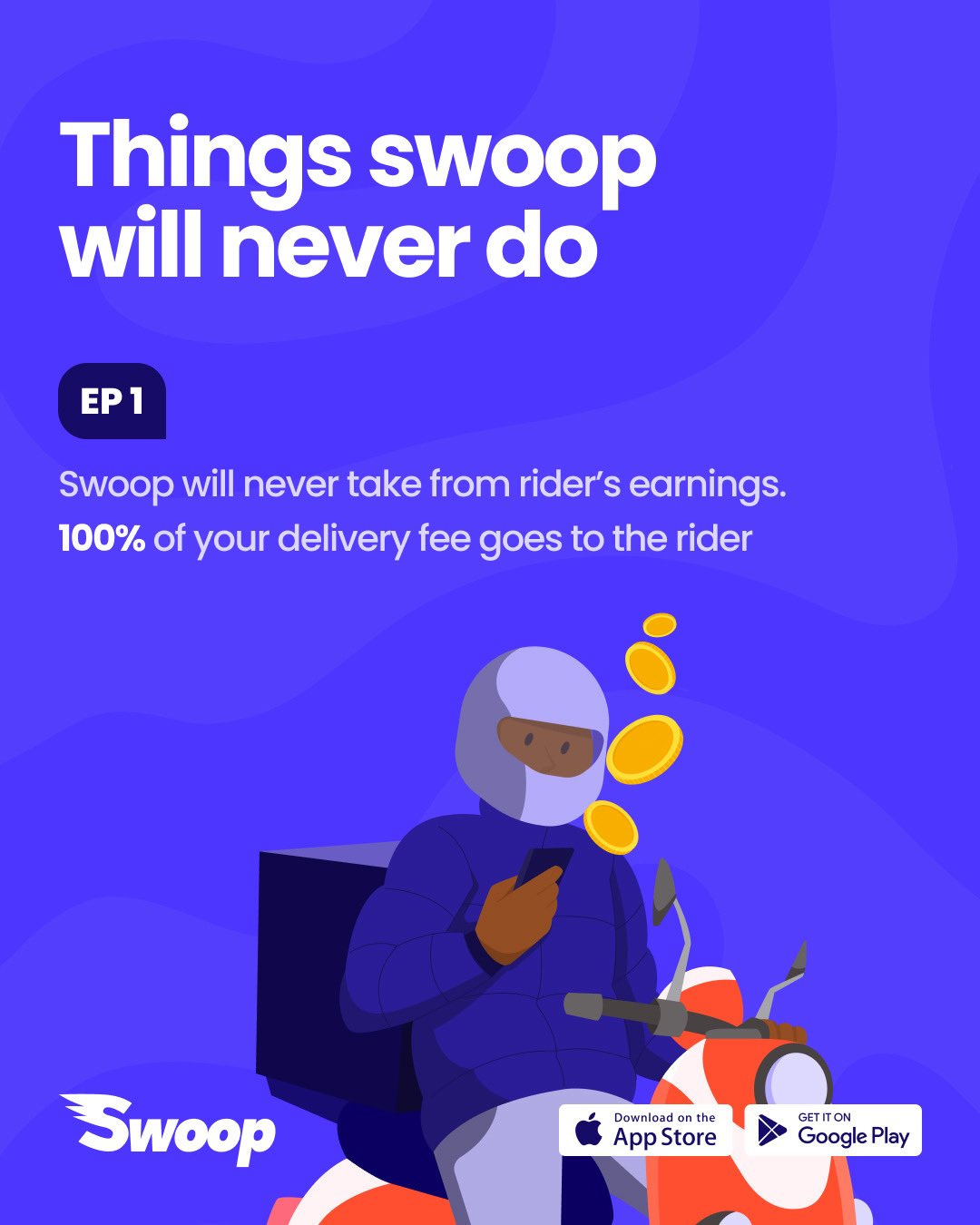
The Lagos product launched first exclusively in Yaba, with an unusual structure for a Nigerian food delivery operation: 100% of delivery fees go to the courier, with a flat 7% handling fee on order value charged to the customer. Riders are independent contractors.
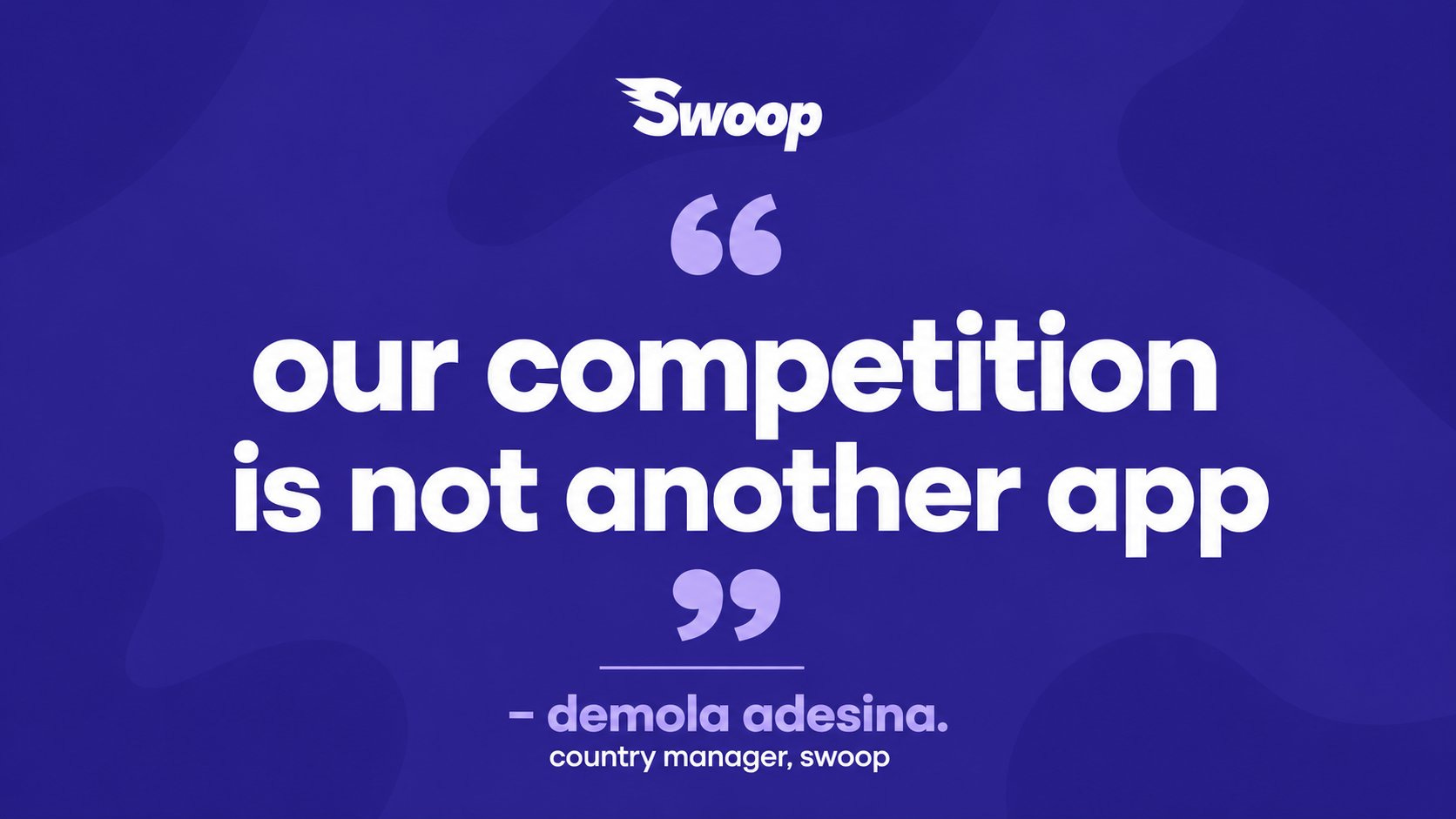
Swoop’s Nigerian country manager, Demola Adesina (ex-Jumia), gave TechCabal a framing worth highlighting.
“It’s super hard to build a super app, and our investors recognise that. They recognise that you need a bit of runway and foundation to be able to do the things that you need to do operationally.”
“We think that the food delivery space in Nigeria is still significantly under-penetrated. Our target is not existing consumption but the users that are not consuming. We are not getting into a war with other platforms. We are trying to grow the pie.”
“Food delivery is a metric for how developed the ecosystem is. If you get food delivery right, you can essentially be the node of the ecosystem.”
Adesina has explicitly named payments as the second vertical. The benchmark companies, per Aubrey’s own statements, are Kaspi (Kazakhstan) and WeChat. The five-year plan is a payments-anchored super-app rather than a delivery business that pivots into payments, and he is right that Nigeria has not yet had a player who built that way deliberately.
Whether this works is a separate question.
Early winners
So who actually wins? Because the company-level outcome is not the only one that matters. Ceteris paribus, the early winners should be:
Riders. Swoop pays riders 100% of delivery fees. Chowdeck and Glovo either match it or watch their fleets walk, and at their scale, they can afford to compete here. Within months, riders’ take-home pay should rise across the sector because there is a new competitor they cannot ignore. We have seen this before: when capital floods a Lagos mobility category (MAX, Moove, Gokada, Uber, Bolt), drivers end up with financing, vehicles and better income they would not otherwise have had.
Talent. Swoop is hiring, and the incumbents now have to defend their share. The floor on every food-delivery role in Lagos (engineering, ops, marketing, growth) just moved up. Two years at Chowdeck or Glovo now comes with a real outside option, and the market reprices accordingly. The same operator pool that produced notable alumni from the likes of Jumia, Paystack, Interswitch, and OPay will grow again.
Restaurants. Chowdeck has been quietly raising fees for months, as a viral complaint from a frustrated customer recently made clear. Restaurants now have an alternative offering low introductory commissions. Whether they switch or simply use Swoop’s offer to renegotiate, they win either way.
Customers. The obvious one. Swoop will subsidise; Chowdeck and Glovo will counter-subsidise. For as long as the runway lasts, Lagos food delivery looks more like 2014 Uber Eats than 2025 Uber Eats: median basket sizes back at $5, before incumbents pushed prices to $36. A wealth transfer from VCs to Lagos customers, courtesy of the venture model. Take it.
The category itself. Lagos just got a new headline data point: “Silicon Valley capital writes $7.3 million into Nigerian food delivery.” It will appear in every fundraising deck for the next 24 months. The next Chowdeck-style raise gets done faster because capital begets capital.
Residue
OPay’s non-core verticals all died, but the user base it acquired with subsidies became a 40-million-user, IPO-bound payments empire. Jumia and Konga both lost the e-commerce war, but Lagos came out of it with logistics, payments and operators. Swoop will leave its own residue. Maybe a new way to pay, maybe a rider network, maybe the next founder, currently a 26-year-old Swoop ops lead who starts something better in 2030. We do not know yet; however, we know the pattern.
Which way, Nigeria?
We spent the 2010s making Jumia versus Konga arguments as if one had to be the real champion; both are diminished now, and we could have all spent that time in the industry acknowledging the efforts it took them to bring Lagos and Nigeria online. A rerun of this is happening in Moniepoint versus OPay, with OPay recast as “Chinese” so it doesn’t count, never mind the thousands of Nigerians it employs, the 500,000-plus agents who earn off its network, and the payment rails half the economy now runs on.
If the capital pays out regardless of whether the company wins or who wrote the cheque, then litigating who deserves funding returns nothing. When American or Chinese or Emirati money puts $7.3 million into Nigeria, the correct response is to open ourselves to everything it leaves on the way through (riders, talent, validation, residue) and send the thank-you note.
It’s a small bet by super-app standards. It will still buy years of subsidies, training, and proof that the Nigerian super-app moment is worth investing in. That pays out whether Swoop is around to see it or not.
Welcome to Lagos, Aubrey. Now let’s see what gets built.
*Thank you to Ngozi Chukwu for her feedback and editing of this piece.
**The views expressed in this article are entirely my own and do not represent those of my employer.