

Hello There,
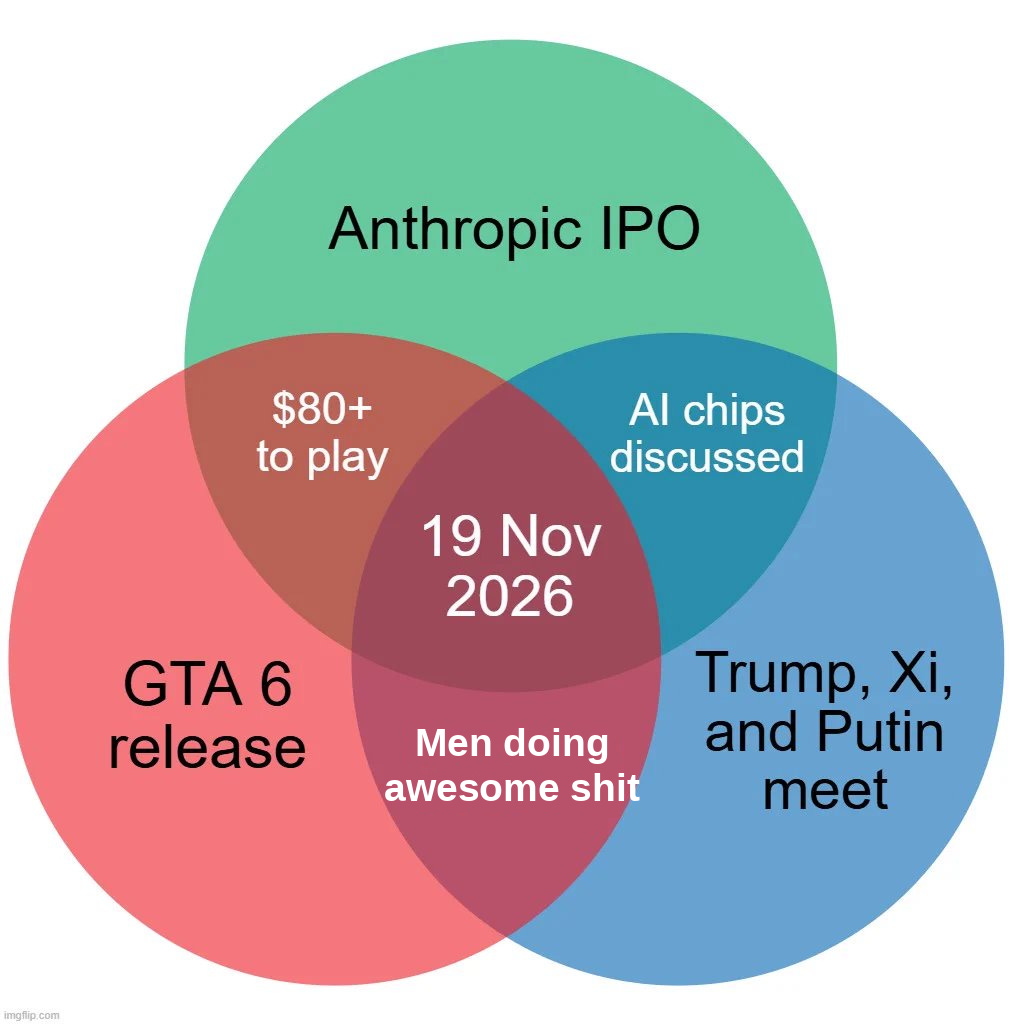
Happy Anthropic IPO Day, International Men's Day, and GTA VI Day to all who celebrate.
Looks like Cybersecurity Awareness Month was extended, as we have observed a Binance hack, the FAA grounding, outages at Microsoft and the NSA and critical vulnerability events at 200+ companies. Coverage and updates on this can be found on the Fintech is Easy Twitter/X account. (follow the account for more fun updates)
OPay pulled its IPO due to regulatory inquiries from a non-material market. - Not a Deep Dive Coverage on this is here
OpenAI launched ChatGPT wallet, giving Dots agentic payment capabilities
Google launched Gemini checkout for agents, powered by Google Pay and the Agent Payments Protocol (AP2)
Nigerian lawmakers have approved a bill to categorise fintechs like OPay and Moniepoint as systemically important institutions, and supervise them like banks.
Nigeria now finally has tap-to-pay - This was a 2024 and 2025 Fintech is Easy prediction
The CBN released a new regulation for stablecoin issuers.
And now, on to the newsletter.
A few years ago, I read the book, “Ernest Ndukwe, The GSM Story”. After that, I reached out to Aaron Ukodie, one of the foremost Nigerian journalists who covered the telecoms boom, to get all the books he had written on the subject of Nigeria’s ICT development spanning 50 years.
And then one day, just like the Interswitch episode, another AI slop video I saw on Instagram, which I sent to Muyiwa, led to the creation of the latest episode of Africa Built.
The new episode of Africa Built is out, and this one is different from anything we have done before, as it’s our first video interview for the podcast.
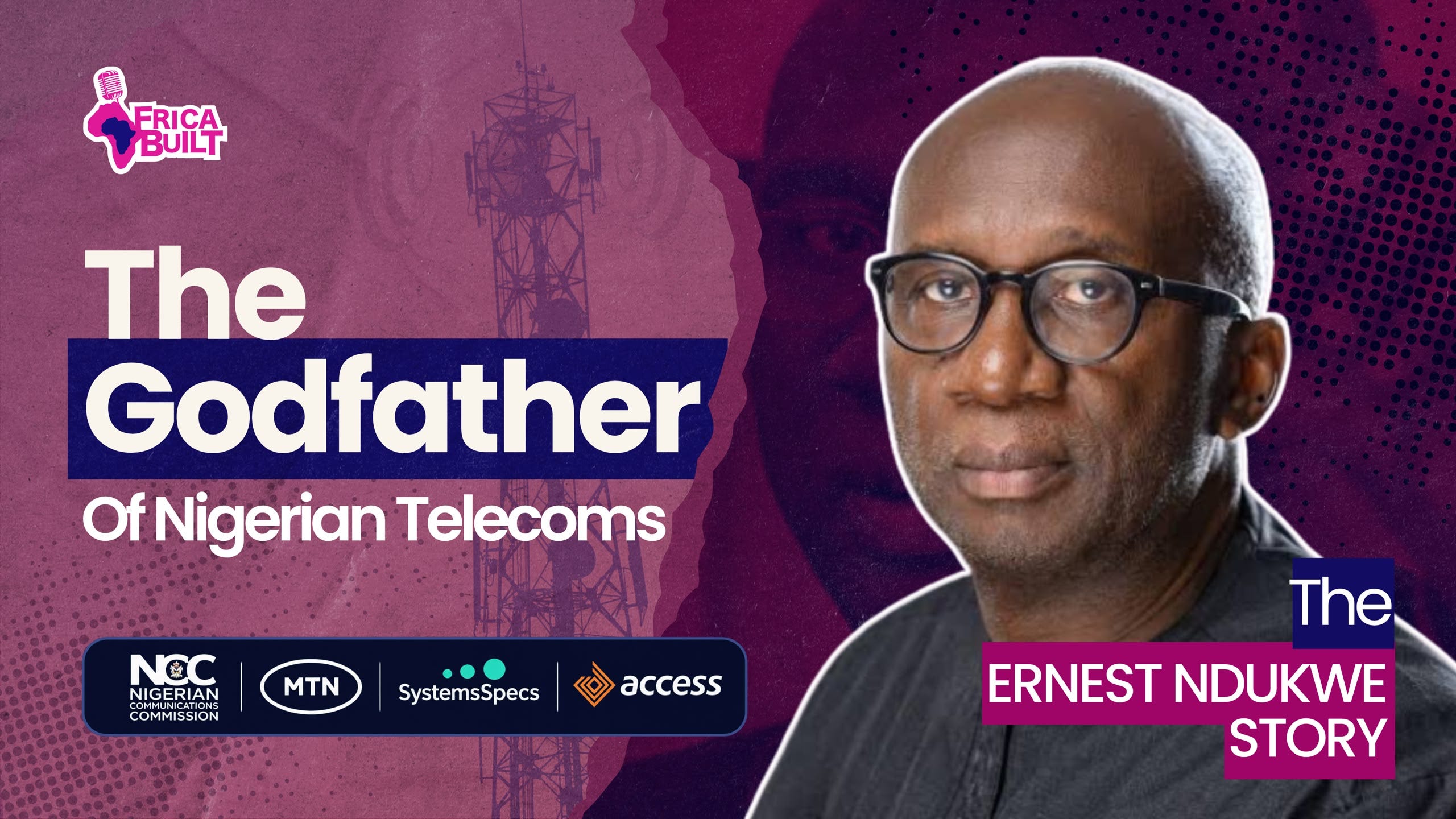
We sat down with Dr. Ernest Ndukwe, Executive Vice Chairman and CEO of the Nigerian Communications Commission(NCC) from 2000 to 2010, and now chairman of MTN Nigeria.
In the year 2001, the first GSM call in Nigeria was made by Strive Masiyiwa, the chairman of Econet Wireless.
The receiver of that call was Dr. Ernest Ndukwe, the regulator at the Nigerian Communications Commission (NCC).
With the words “We’re live!” Nigeria ushered in a new era of telecoms and internet revolution.
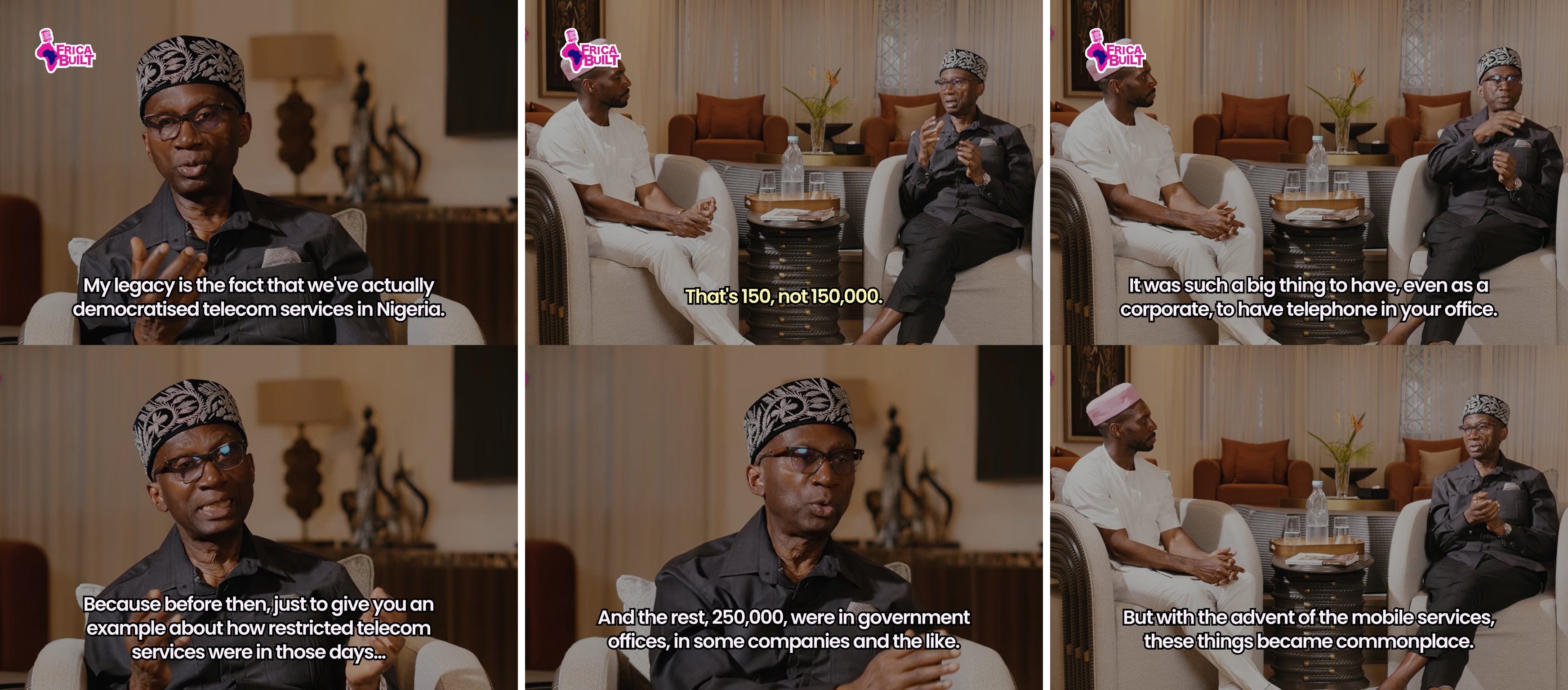
When Ndukwe took the NCC job in 2000, Nigeria had fewer than 400,000 working telephone lines for some 120 million people, a teledensity of about 0.4 lines per 100 people.
By his own account, almost 200,000 of those lines sat in government offices and private organisations. By the end of his tenure in 2010, active lines were reported at over 80 million, and this year MTN Nigeria alone crossed 100 million subscribers.
Eleven years inside the industry
RCN sent him to Harris Corporation’s facility in Melbourne, Florida, in 1976, on his first trip outside Nigeria, for six months of training. He did well enough to be one of three engineers kept back for another six months, to train the next batch of Nigerians and take an advanced satellite communications course.
Back home, he moved to GEC Telecommunications Nigeria in 1981 and became managing director in 1989, running it for eleven years through its renaming as General Telecom. GEC was a Nigerian-registered company, 60% Nigerian-owned and 40% held by GEC in the UK, and it competed with Siemens and other foreign suppliers for NITEL contracts. In his telling, it competed on discipline: you would never hear a scandal about GEC buying contracts. So Ndukwe spent the 1980s and 1990s selling equipment to the monopoly he would later have to open up.
He also became president of the Association of Telecommunications Companies of Nigeria, president among his fellow CEOs, as we put it to him. That role put him on the conference circuit, giving speeches urging the government to deregulate and let private companies improve Nigerian telecommunications, while Ghana, Cameroon, Algeria and Tunisia were already running GSM and Nigeria was still analogue.
The market that was not
The government had set up the NCC in 1992, but Decree 75 covered only the privatised part of the industry and left NITEL outside the regulator’s reach. From 1995, a first wave of private licences followed: more than thirty ISPs, then hopefuls like Multilinks, Intercellular, Zoom Mobile and Starcomms. NITEL was the only network that mattered, and it refused to interconnect the newcomers, which the commission had no power to make it do. They were, in his words, isolated companies on their own.
Mobile licences fared no better. In the late 1990s the military government issued twelve of them, apparently nine for GSM, and not one network was built. One holder, Motophone, would later take the NCC to court over the 2001 auction and lose. A licence handed out quietly can be taken away quietly, which is why nobody was going to spend hundreds of millions of dollars on towers on the strength of one.
Everyday access was worse. Having a telephone in an office meant a PBX and a negotiation with an exchange, and international calls were restricted and expensive. That was the entire industry he was about to inherit.
The call
The job he actually wanted, he has said more than once, was managing director of NITEL, so he could make some of the fixes he kept recommending from the outside. Instead, in February 2000, the call came for the NCC, and President Obasanjo appointed him on 18 February. He learned later that the government had sent security people as far as his village for background checks. Accepting meant leaving GEC for what he describes as going from the known to the unknown, and he took it, he says, as a chance to put his money where his mouth was and practicalise a decade of advocacy.
The president’s instructions, as he recalls them, were to improve services quickly, to run a licensing process that brought in competent international operators, and to build the NCC into an institution of international standard.
The auction
The licensing process for the digital mobile licence left bidders free to choose their technology, and both eventual operators chose GSM.
To qualify for the auction, a $20 million deposit was set to keep unserious bidders out.
Five companies qualified: MTN Nigeria, Econet Wireless Nigeria, Communications Investments Limited (CIL), MSI-Celtel and United Networks Mobile, an Orascom-led consortium. They met at the NICON Hilton in Abuja from 17 to 19 January 2001 for what became the world’s first ascending clock spectrum auction. Three slots went up for bidding, and the fourth was reserved for NITEL’s mobile arm, on condition that it paid whatever price the auction closed at.
The rules did the work that trust usually does. Bid teams sat in separate rooms with independent observers, each round lasted twenty minutes, and results went public while the auction was still running, so Nigerians in the diaspora and observers around the world could follow it as it happened. At each announced price, a bidder could accept, waive or drop out.
On the third day, the price reached $300 million. CIL accepted, Econet and MTN waived, and MSI-Celtel, which many expected to win, dropped out. With three bidders left for three licences, the auction ended under its own rules, and the winners paid $285 million each.
In his first year, he earned the Nigerian government $855 million for the licensing of three licences.
Everybody underrated the hunger
Before the licences, the NCC had asked the operators how many lines they could deliver. In his telling, the answer was 100,000 lines a year, or 500,000 in five years, which sounded ambitious against the existing base.
The government’s own 1999 policy aimed for 1.2 million lines in two years. Econet launched commercially on 7 August 2001 and MTN on 8 August, a day before the regulatory deadline, and within a year the two networks had 1,569,050 subscribers between them.
His tenure was not only the auction. The Nigerian Communications Act of 2003, which the commission helped craft, replaced Decree 75, brought NITEL inside the regulator’s reach and still governs the industry today.
The Act also created the Universal Service Provision Fund to extend services to underserved and rural areas and to put computers and internet access into schools and colleges.
A near-parity interconnection regime followed in 2005, and in 2006 the NCC moved operators onto a single Unified Access Service Licence.
The internet part of the story runs through all of this. In his telling, the first internet service in Nigeria arrived at Yaba College of Technology around 1995, and for years the internet lived in specific offices, companies and campuses. GSM changed the address of the internet, moving it onto the handsets ordinary people already carried, including in villages, where a person at home could now call China. That, he says, is the legacy he claims: the democratisation of telecommunications services in Nigeria.
The cool-off
What happened after the NCC is, in its own way, as instructive as the auction. He rested for a few months, joined the strategy faculty at Lagos Business School, where he still teaches, and set up a consulting practice.
He has sat on the board of SystemSpecs, the company behind Remita, since the early 2000s and has chaired it since February 2022. But he refused every invitation from licensed operating companies for eight years. Nobody imposed that cool-off period, and it was not in any statute. He imposed it on himself.
When he finally joined MTN Nigeria’s board in June 2018, it was as an independent non-executive director, without a single share in any telecom company.
In September 2019, when the pioneer chairman Pascal Dozie retired, Ndukwe became chairman of the board, and shareholders re-elected him in April 2026.
On his watch, MTN Nigeria opened its shares to pension funds, wealthy individuals and ordinary Nigerians. He is emphatic about the framing: MTN Nigeria is a Nigerian company, registered in Nigeria and operating in Nigeria.
The regulator who licensed MTN now chairs it.
Watch the episode here and on YouTube
Watch on YouTube · Episode page and chapters
Next Time on Africa Built: It’s definitely not a Boeing.
Africa Built is a Not a Deep Dive x Fintech is Easy production.
Have a correction, a missing piece of the history or a story from inside the industry? Write to africabuiltpod@gmail.com or message us on every social media platform @africabuiltpod or africabuilt.xyz
This series is for education and entertainment, not investment, tax or legal advice.
A Few Nice Links
On the design and implementation of the GSM auction in Nigeria - Chris Doyle and Paul McShane, Telecommunications Policy
The auction that changed everything - Techpoint Africa
Econet founder reveals story behind company’s downfall in Nigeria - Techpoint Africa
One2One, “The Ernest Ndukwe One”, with Tokunbo Shitta-Bey: Part 1 · Part 2 · Part 3
What OPay and Moniepoint’s numbers reveal about fintech economics - TechCabal
Can you send money to North Korea? (and other stories) - Payments Culture