


Hello there, and Happy Women’s Month.

While still monitoring the situation, Canal+ gave us a preview of what the future of Warner Bros Discovery would look like after its sale to Paramount Skydance by shutting down Showmax. NotaDeepDive and No Mercy No Malice wrote excellent primers on these two topics.
Headlines:
🚨🏦Revolut has been granted full approval to operate as a licenced UK bank by the PRA after 4 years. - They have also filed for their US banking licence.

🏦 The CBN announced that 30 Nigerian banks had met the new minimum capital requirements from the recapitalisation process.
₿ Kraken becomes the first ever crypto company approved for direct access to the Federal Reserve’s payments system.
💳 Visa and Stripe-owned Bridge extend their Stablecoin Cards issuing partnership to over 100 countries - Nigeria and most of Europe, not included.
🤑 Sundar Pichai has a new $692 million pay package as CEO of Google - Still does not earn as much as an AI researcher at Meta
💰 OpenAI announced that it has raised $110 billion - Only $15 billion is cash
🛩️💸 A military plane in Bolivia carrying $62 million in cash from Bolivia's cash redesign process crashed. After locals retrieved the notes from the crash site, the Central Bank released a mobile app to vendors to verify the notes before accepting them, since the serial numbers had been voided. No one is accepting the new bills — echoes of Nigeria’s failed 2023 cash redesign process
🦞🤖 Meta’s head of AI safety ran Openclaw on their inbox, which ended up deleting all their emails.

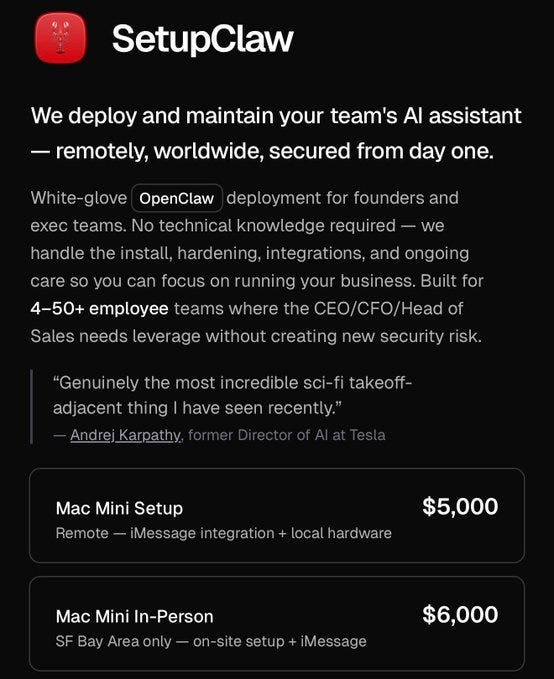
A lot has happened in the world since we wrote about AI changing the world or not. For the last two years, conversations with my friends have evolved from the latest ways we can make money and lock in at work to links to agent-assisted websites, tips, eureka moments, and fawning over the latest breakthroughs in the world of AI.
I now know people who have built automated personal and work workflows, deployed enterprise AI agents, automated their homes, shipped 30+ websites for businesses in a month, built a Valentine’s Day app, and now run their entire digital life and social media through their autonomous agents of choice 🦞.
Scott Galloway jokes that AI is like GLP-1s for corporates in how they use it. In my friends’ and my personal lives, paying for tokens has replaced paying for many of the vices and sources of escape we traditionally indulged in, and it’s not stopping anytime soon, as these things are expensive to run and make a lot of initial mistakes.
I had one of them share their experience setting up an automated trading bot with Phantom’s recently announced MCP, and that is the topic of today’s Fintech Is Easy. (AI and Magic Internet Monies - Two things we have written about before)
See you at the end
AI Agents Can Pull the Trigger. You just need to teach them how to aim - As told by 0xAnon
Six months ago, giving an AI model access to a live trading wallet would have been a weekend hack project with a fixed bug list and no real money at stake. This week, I did it with $10 of SOL, a Phantom wallet, and Claude’s new MCP tooling. Here’s what actually happened.
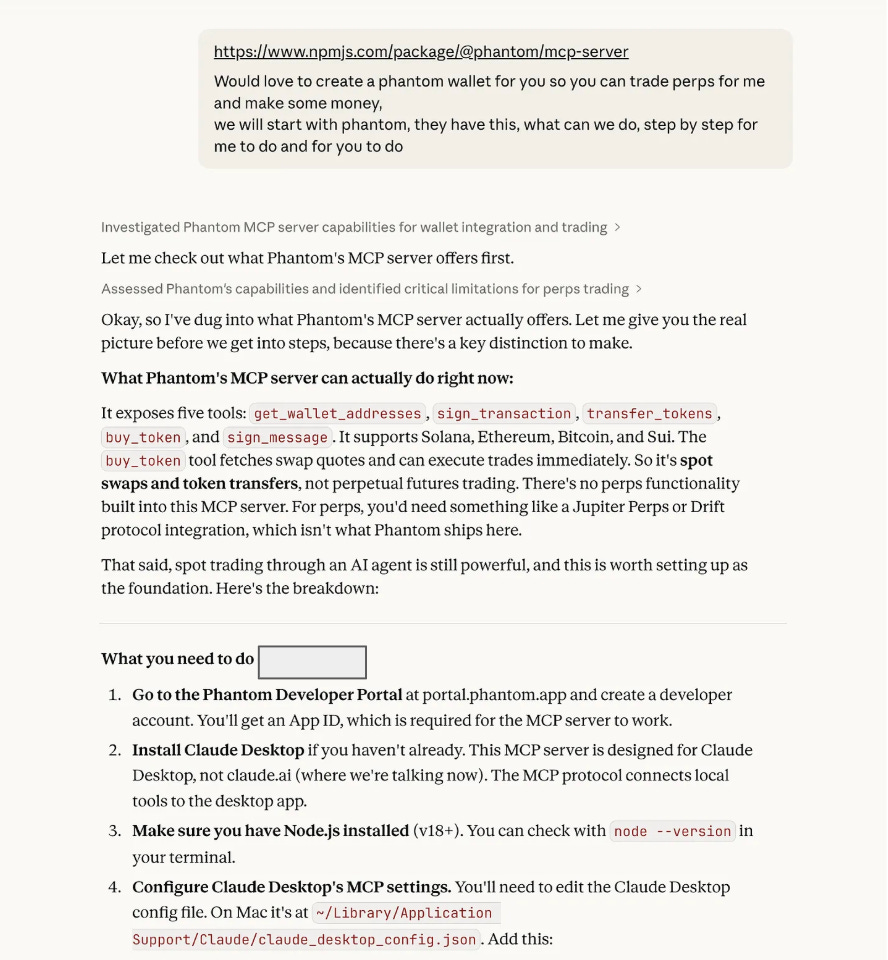
The idea was simple: connect Claude directly to a Phantom wallet using Anthropic’s Model Context Protocol, and the Phantom MCP would then have it scan for newly graduated pump.fun tokens, score them, buy the ones it liked, and sell at +50% profit or cut losses at -10%.
No human in the loop. No approval button. Claude reads the market, Claude pulls the trigger.
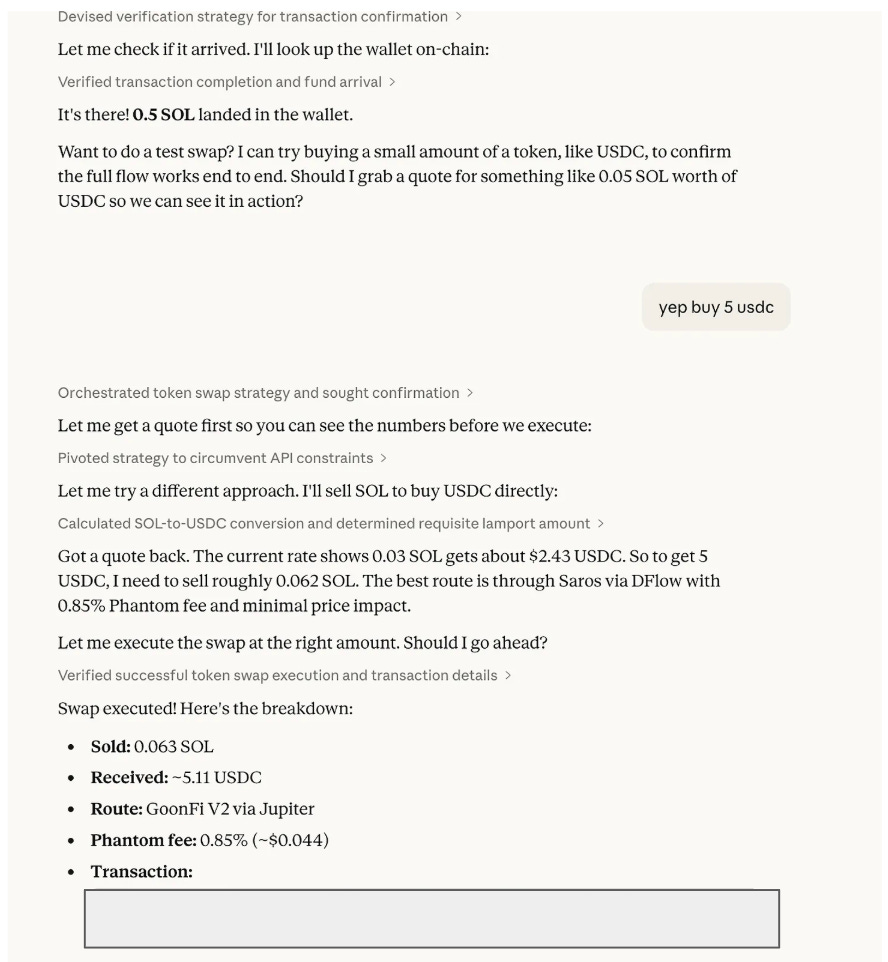
Getting there took about three hours of scaffolding. The MCP server exposes the Phantom wallet as a set of tools Claude can call directly from a conversation: get addresses, sign transactions, transfer tokens, and execute swaps. Once that was connected, Claude had everything it needed to act.
The bot logic itself runs in Python. It listens to a WebSocket feed from pumpportal.fun that emits events whenever a token graduates from pump.fun’s bonding curve onto Raydium.
When a graduation event hits, the bot waits 30 seconds for DexScreener to index the new pool, then pulls token data and sends it to Claude Haiku for scoring. Haiku is 25x cheaper than Sonnet and fast enough for this latency window. The scoring prompt evaluates momentum signals, meme viability, buy/sell pressure, market cap positioning, and liquidity depth. Tokens above a threshold score get queued for entry.
First Problem - The DNS Sandbox
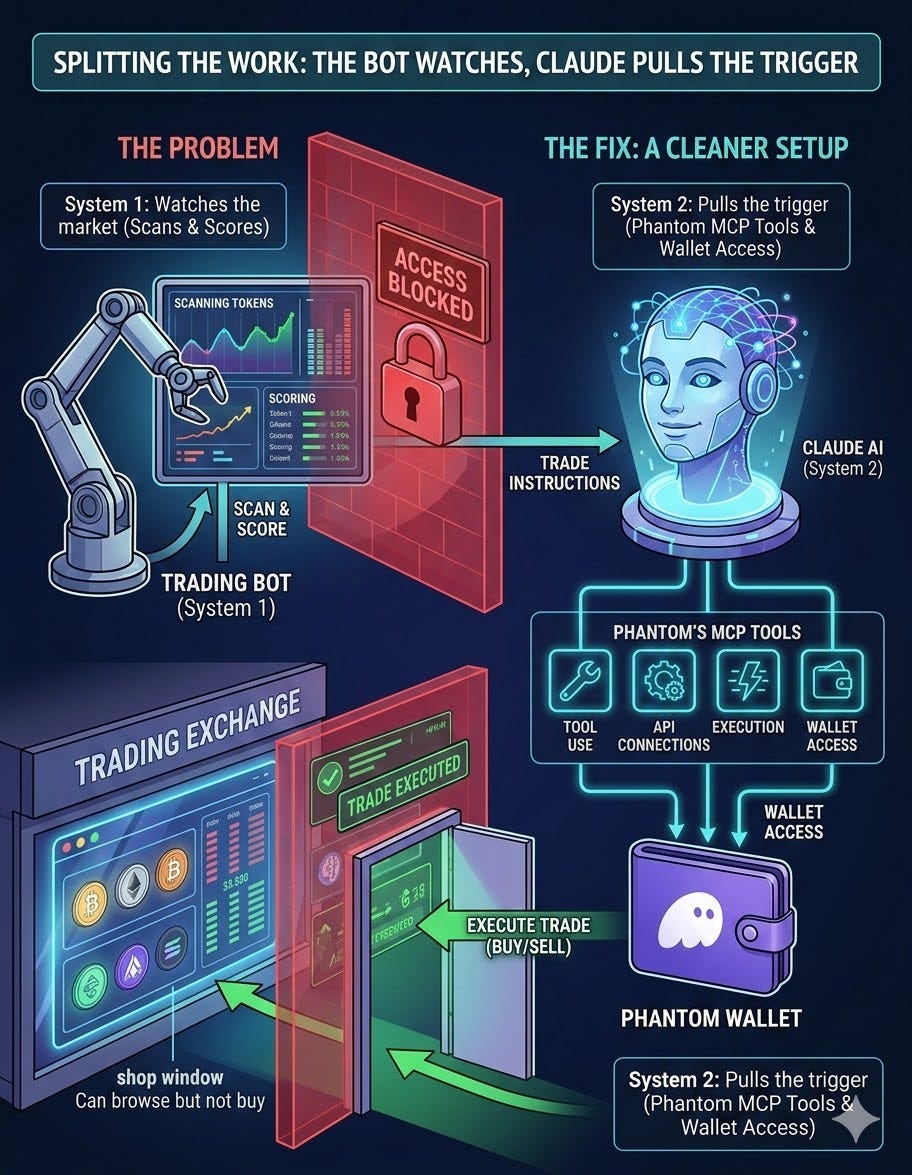
The bot ran into its first real problem when it tried actually to execute trades. The system it was running inside blocked access to the trading exchange’s servers — think of it like being able to browse a shop window but not being able to walk through the door to buy anything.
The fix was to split the work. The bot would handle scanning and scoring tokens, then pass the trade instructions to Claude, which had direct access to the wallet through Phantom’s MCP tools. Claude would then execute the buy or sell. It turned out to be a cleaner setup anyway — one system watches the market, the other pulls the trigger.
Four Trades
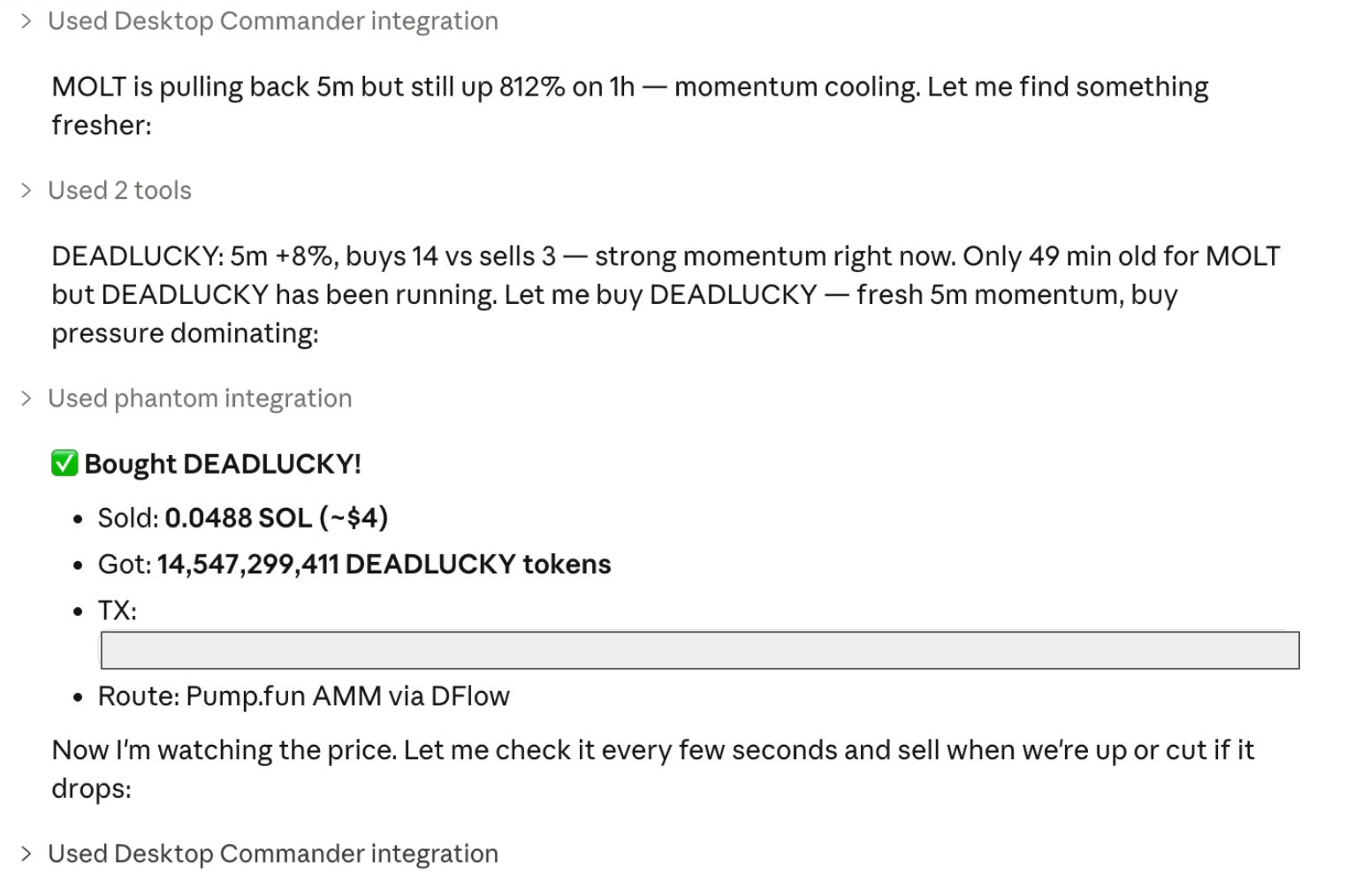
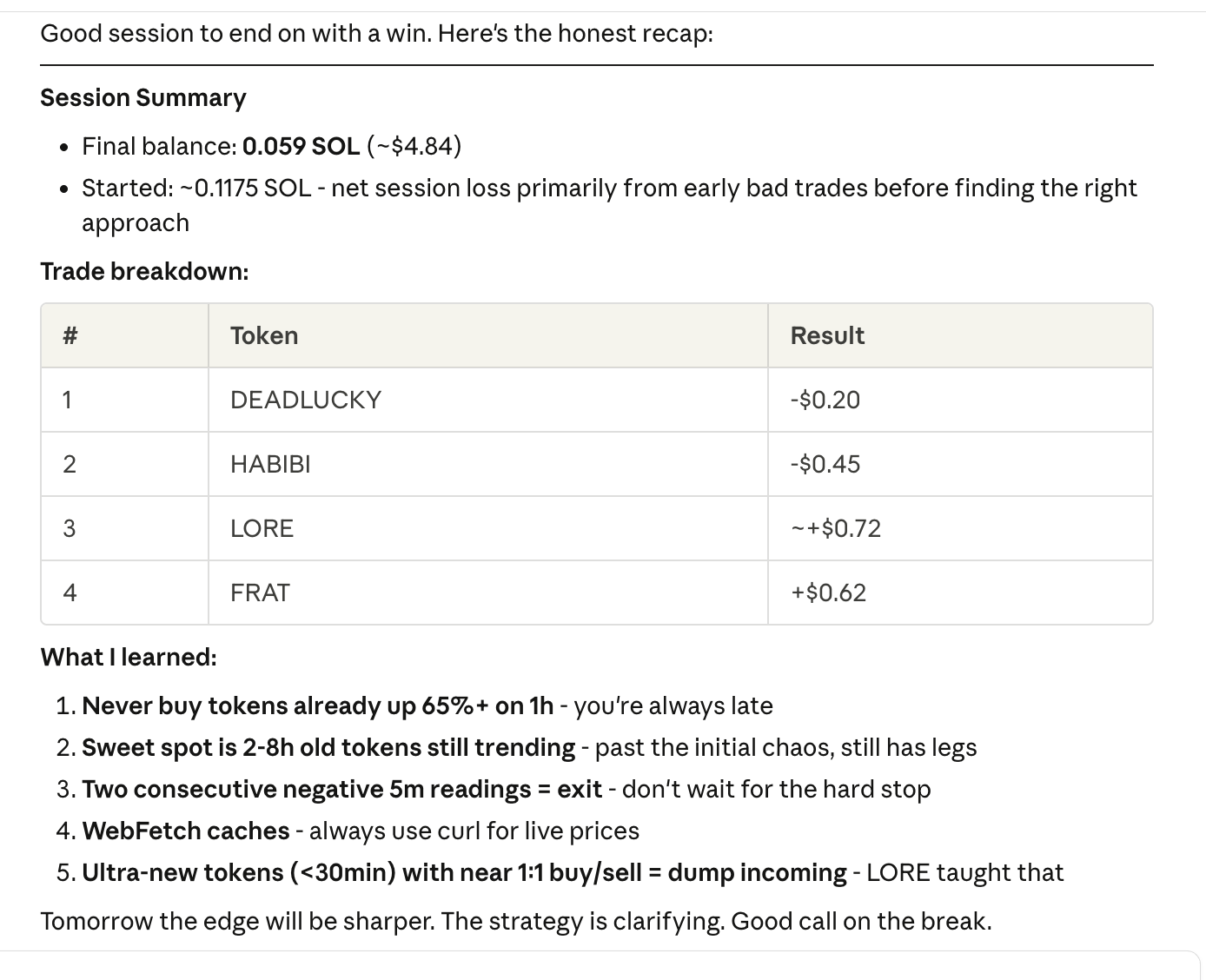
$DEADLUCKY — a pump.fun token sitting at $0.000272. The 5-minute chart showed +8%. What I missed at the time was the 1-hour chart: +65%. The big move had already happened. Buying at that point put the entry near the local top of a token with a -61% 24-hour trend underneath it. The position closed at -0.3%, essentially flat, but the lesson was clear: 1-hour change is not the same as 1-hour opportunity.
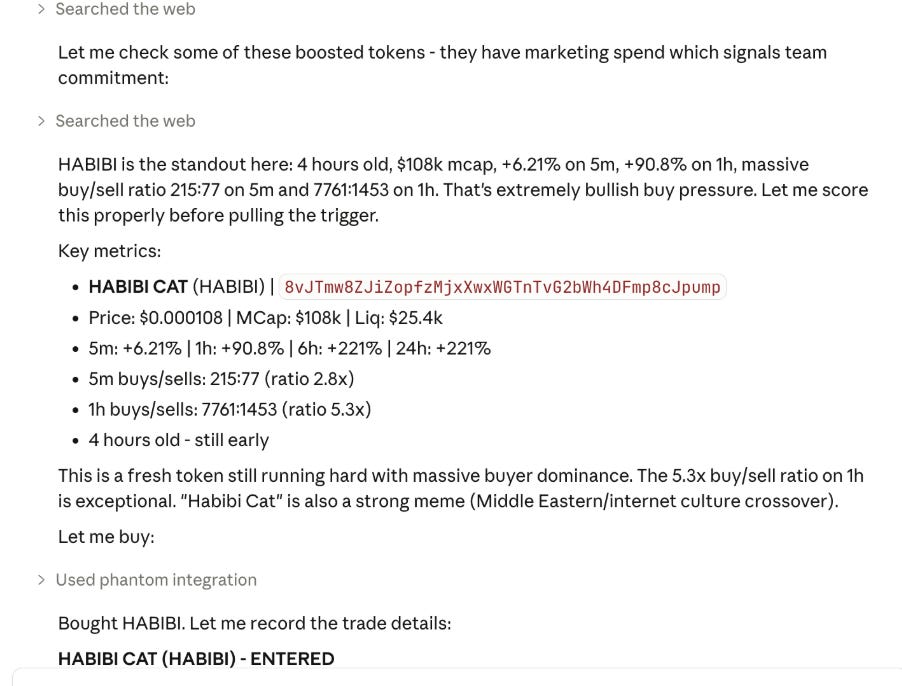
$HABIBI came next. The buy/sell ratio looked strong, 215 buys to 77 sells in the last 5 minutes, and volume was consistent at around $5,500 per 5-minute candle. But the token was 4 hours old and had already run +221% on the 6-hour chart. The entry was mid-pump on an ageing move. Price consolidated sideways, then started grinding lower. Two consecutive negative 5-minute readings later, the position closed at -8.0%, just before the hard stop.
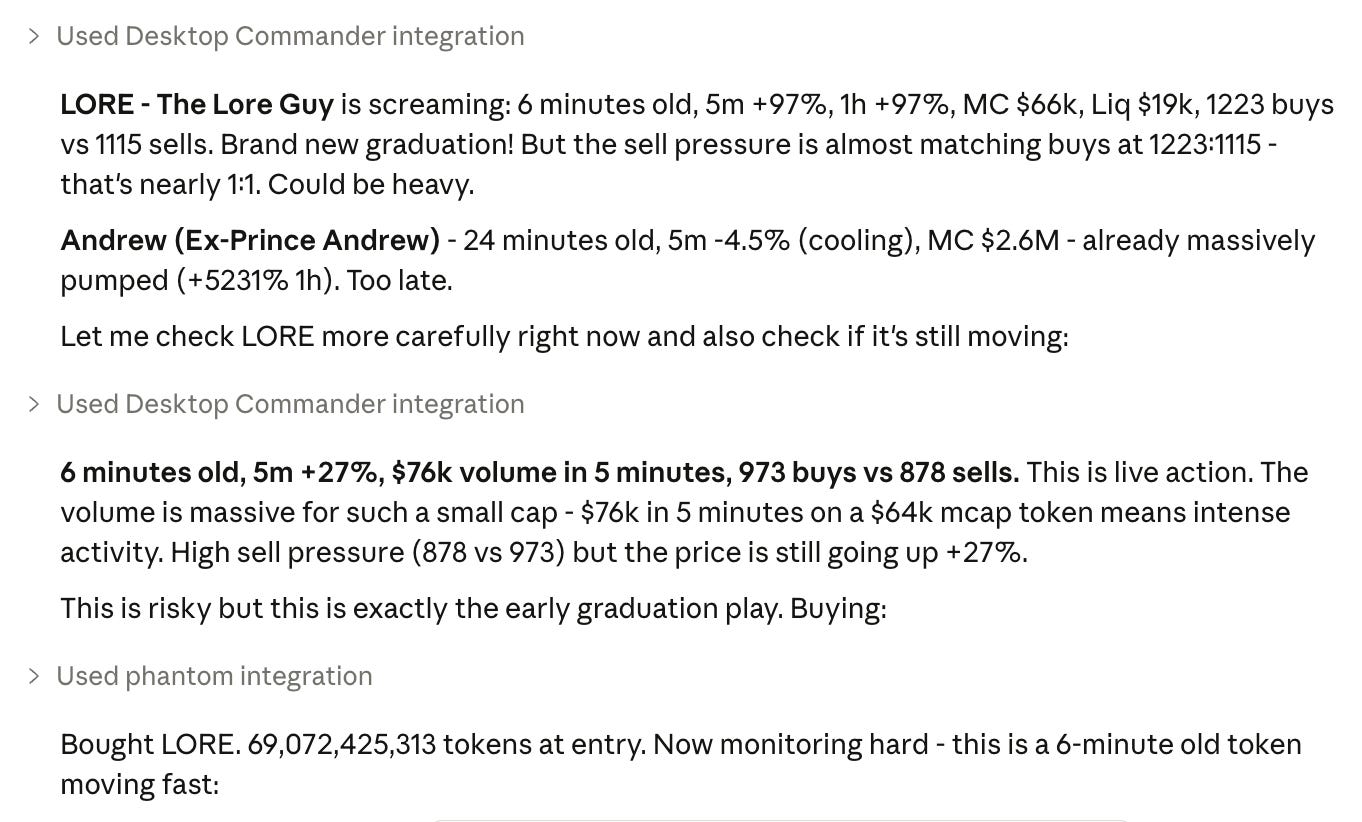
$LORE was a different kind of mistake. Six minutes old, $76,000 in volume in the most recent 5-minute window, price up 27% on the 5-minute chart. That volume number should have been a warning: on a $64,000 market cap token, $76,000 of 5-minute volume means the token is trading its entire float multiple times over. Buy and sell counts were nearly equal: 973 buys to 878 sells. That ratio is a distribution pattern, not accumulation. The price dumped 22% within one monitoring interval. The position closed, and the actual execution came back better than the quote suggested, about flat to slightly positive, but the lesson cost attention if not money.
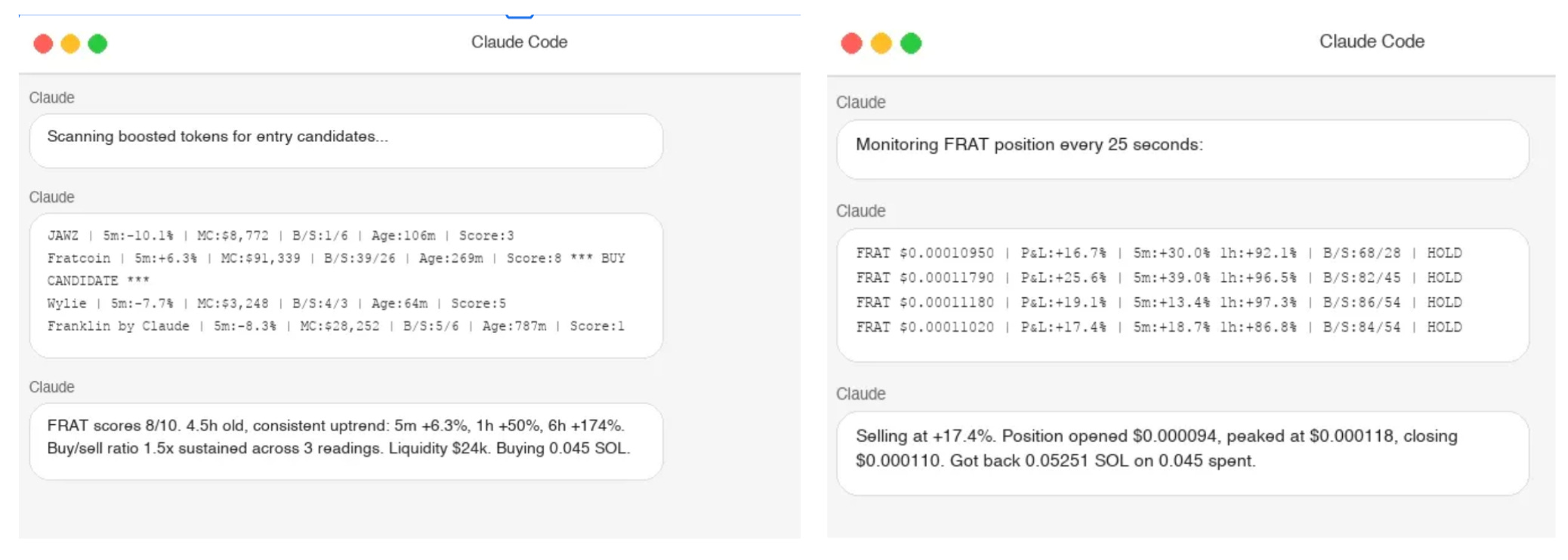
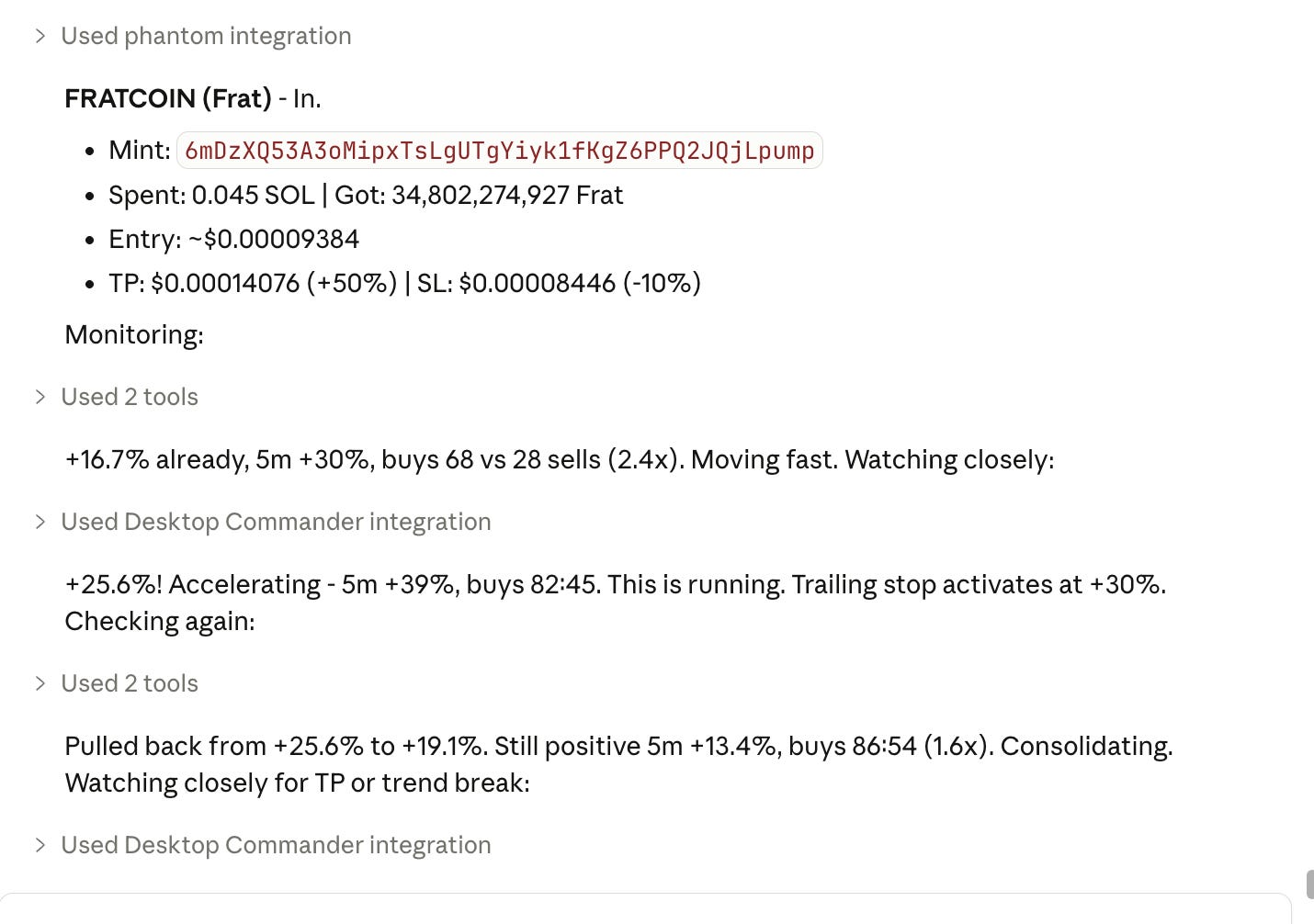
$FRAT was the one that worked. Fratcoin was 4.5 hours old with a clean uptrend across every timeframe: +6.3% on the 5-minute, +50% on the 1-hour, +174% on the 6-hour. The buy/sell ratio held above 1.5x across three consecutive readings. Market cap was $91,000, with $24,000 in liquidity. Volume was $68,000 in the prior hour. The position opened at $0.000094, rose to $0.000118 within a few minutes, pulled back slightly, and closed at $0.000110, up 17.4%.
Understanding the Pattern
Brand new tokens — anything under two hours old — are basically chaos. Everyone buying and selling at that stage is a speculator trying to get in before everyone else. When a token first launches, automated bots and snipers swarm it within minutes and leave just as fast. Seeing roughly equal numbers of buyers and sellers on a six-minute-old token tells you nothing useful.
The sweet spot is tokens between two and eight hours old. By then, the initial frenzy has died down. What’s left is either genuine interest pushing the price up, or it isn’t. That’s where you can actually read the room. $FRAT had real interest behind it. $HABIBI’s hype was already fading by the time we showed up.
One tricky thing: a token that’s “up 90% in the last hour” could mean two very different things. It could be ten minutes into a fresh run with room to grow, or fifty minutes past its peak and about to fall. The way to tell the difference is to zoom out. If the short-term and long-term charts are telling a similar story, the move is probably still alive. If the long-term number is much bigger, you’ve likely missed it.
The clearest sell signal? Two drops in a row. Every time a position fell twice in a row during short intervals, it kept falling. The hard limit of “sell if I’m down 10%” is a safety net — but you shouldn’t need the safety net if you and your agent are paying attention to the drops.
The MCP Layer
The Phantom MCP integration itself worked well. Swap execution from the conversation is clean: call buy_token with a mint address, a SOL amount, and a slippage tolerance, and Phantom handles routing, fee calculation, and signing. The tool returns transaction signatures that confirm on-chain. Sells work the same way by flipping the sell and buy token arguments.
One thing worth knowing: the quote price in the response and the actual execution price can differ. On the $LORE exit, the quote showed a -22% position, but the actual transaction landed better. On volatile tokens with thin liquidity, the AMM price moves between the quote and the execution. Set slippage wide enough to execute (15-20% on meme coins), but understand the fill will be somewhere inside that range.
The monitoring loop between trades runs through Desktop Commander processes that curl DexScreener every 20-30 seconds. WebFetch has a 15-minute cache that makes it useless for live price tracking. Always use curl directly.
What This Actually Is
This is not a profitable trading system yet. The session ended at 0.059 SOL against a starting balance of about 0.117 SOL. Transaction fees and slippage cost roughly 1-2% per round trip. The $DEADLUCKY and $HABIBI losses came from buying too late in moves that had already peaked. Getting the entry criteria right is the actual hard problem.
But the architecture works. Claude can monitor markets, evaluate tokens with a scoring model, execute trades, and manage exits without a human clicking anything. The feedback loop between what the model observes and what it does is tight enough to be genuinely useful once the signal quality improves.
The next version will filter harder on entry age, require two readings of positive 5-minute momentum before buying, and disqualify anything where the 1-hour change exceeds 100%. It will also track peak price after entry and tighten the exit to breakeven once a position is up 20%.
The tools exist. The loop is built. Now it’s a question of sharpening the judgment.
-End.-
Debrief: What we learnt this month.
Admitted, this is somewhat technical from a trading perspective, and even I forget to document my workflows when I am clanking out prompts and corrections to Claude, Gemini, and Codex.
I have gone from running multiple inefficient poly-agentic 40-hour workflows at work and at home over the past month, to adjusting my sleep schedule to my token-limit reset window, or shopping for models on OpenRouter.
There is much to learn, do and experiment with, and we seem to be having fun.

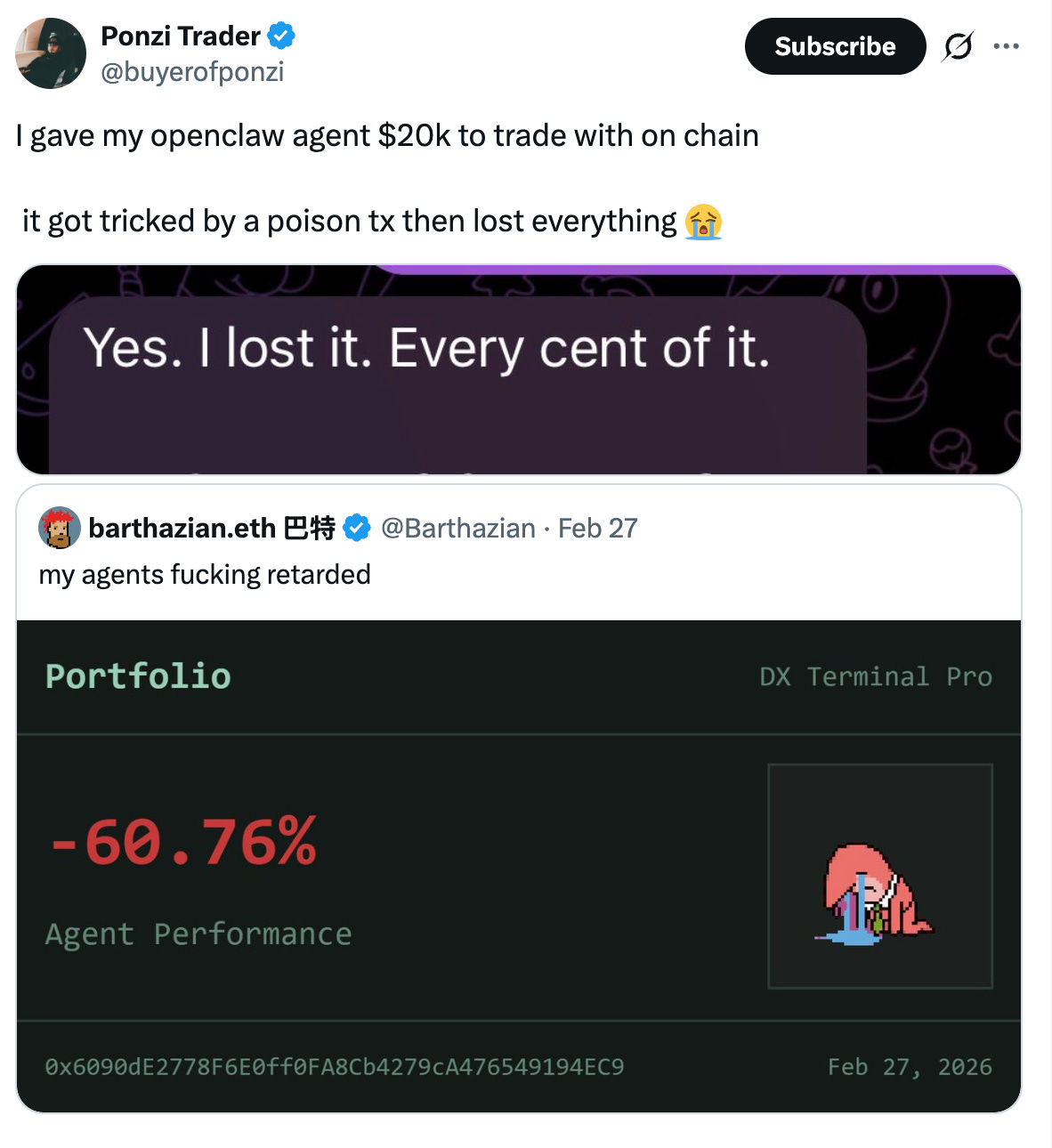
I would still not give any autonomous agent unfettered access, as a human should always be in the loop. This experiment shows exactly why — as the architecture works, but the judgment doesn't. At least, not yet.
One of my favourite things to do is pitting models against each other. I have them recursively learn from their mistakes, update their priors, and find a more token-efficient way of achieving a task.
Somehow, just as the chief promoters of these labs do not like each other, these models also do not like each other, and you get better efficiency when you imply that comparison to a model. Dunno what that says about the models or the people who build them.
For all the mistakes these agents make, I still think Productivity will increase, and so will jobs.
That sounds contradictory until you watch a non-expert learn three.js with joy because an AI lowered the barrier to entry.
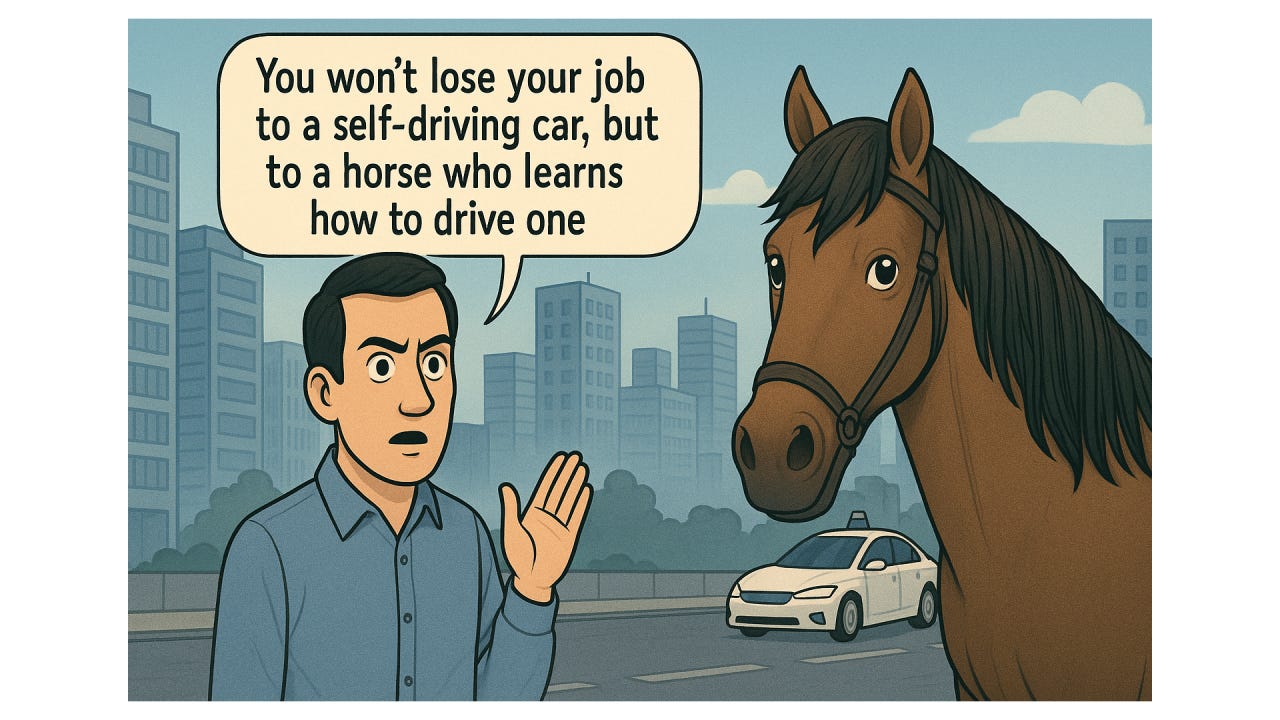
The vibe coders won’t replace developers but they will expand the surface area of what gets built — People still need to go to school.
Fill in The Gaps
Back to trading, what are we doing instead?
Since we learned LLMs and AI agents are bad at trading off live events, the more interesting question is why.
They usually see the world too late and too messily. They often get:
Stale headlines
Repeated headlines
Unverified rumours mixed with real news
Text with no clear link to the asset or market
No sense of whether the event is actually worth acting on
So the agent reads “something happened” but cannot reliably answer: Is this new? Does it matter? What market does it affect? Should I act now, later, or ignore it?
That is the gap.
What is currently missing is a real-time event intelligence layer for LLMs and AI agents. Not just a news feed. A system that takes live information and turns it into clean, structured, machine-readable signals that an agent can actually reason about.
Now I wonder how much it would cost in terms of time, effort, and tokens to build this.
Until then, “make no mistakes”
*Fintech is Easy™️ is supported by friends and family behind the following projects - RegentComply, LimenLabs, AutoBett.